Saturday, November 17, 2012

The Naga problem


Come Assembly elections in Nagaland, orchestrated noises claiming that peace is within reach are bound to get louder. Political actors know that traumatised by decades of external and internal bloodletting, the Naga craves nothing more than peace. The recent demonstrations of competitive eagerness by Chief Minister Neiphiu Rio and Nagaland’s legislators to support the ‘peace’ purportedly being cooked between Delhi and the NSCN (IM) were nothing but drama. In a political two-step, Union Home Minister Sushil Kumar Shinde has assured the Nagas of a ‘peace’ gift before the elections early next year.

The Naga public, however, is all too familiar with this periodic show. They know that peace is a distant dream — not inherently distant but because Delhi, by design or default, makes it so. They know that by ignoring the crucial stakeholders and pampering a set of gun-toting men who have little resonance with the broad Naga family, Delhi might cobble together a deal — one that will bring anything but peace.

The polemics of the fractious Naga politics have been rendered more complex by Delhi’s reckless interventions. Instead of appreciating the intricacies of the Naga polity — comprising over 25 tribes, each a proud owner and inheritor of a distinct culture, language, tradition and geography, espousing a distinct world view, falling within the broad rubric of the Naga family — Delhi deals with it as if itwere a homogenous collective with common aspirations. Thus it believes that making a deal with one set would satisfy the rest. How else to explain its abiding faith in the peace process with the NSCN (IM), quintessentially an entity of Tangkhul tribes of Manipur, having little resonance with other Nagas notwithstanding its pan-Naga rhetoric?

Powerful groups ignored

There are other potent Naga militias aligned along tribal lines not in the orbit of the Centre’s peace enterprise. The NSCN (K) holds sway over almost the entire eastern Nagaland — nearly half the State and its people — and resonates well with the locals including the Konyaks, the largest of Naga tribes.

The NSCN (KK) — essentially a militia of the Sumis, one of the larger Naga tribes — control a large swathe of Nagaland adjoining Manipur and also has heavy presence in Dimapur district. The Naga National Council (NNC), the mother of all Naga militias though now a rump of its older self, deeply resonates with the Angamis, the second largest Naga tribe, and their kin tribes in Kohima and adjoining regions. Besides these militias, the traditional bodies that carry much weight with their respective tribes, are also not in the reckoning of Delhi’s peace enterprise.

The peace project, thus severely truncated, got further undermined with the exclusion of the Nagaland State government. I.K. Gujral, the Prime Minister who presided over the formalisation of engagement with the NSCN (IM) in 1997, decided to ignore the State government. He did it, in the face of professional advice to the contrary, to placate the belligerent Th. Muivah, the NSCN (IM) supremo. To Mr. Muivah, the popularly elected Nagaland government was illegitimate and S.C. Jamir, the then Chief Minister, was his bĂȘte noire . Nagaland and Delhi had different political dispensations at the helm then, making it easier for Mr. Gujral to ignore Mr. Jamir. Subsequent governments in Delhi preferred not to rock the boat and nonchalantly carried on with the charade.

Having achieved exclusion of the State government from the process, Mr. Muivah insisted on Mr. Jamir’s removal. He knew his biggest challenge was not managing a distant Delhi but an inconvenient Naga government at home. In the run-up to 2003 elections — the first after the ceasefire — he threw tantrums seeking Mr. Jamir’s dismissal and holding elections under President’s Rule. K. Padmanabhaiah, the Centre’s interlocutor, played along and sought to influence L.K. Advani, the then Deputy Prime Minister and Home Minister. Mr. Advani was not moved, but the Assam Rifles — a Central force with the mandate to enforce the ceasefire rules and ensure that armed NSCN (IM) cadres remained confined to designated camps and did not interfere in the elections — turned a blind eye to widespread violations by the outfit.

Tactical alliance

Mr. Muivah’s boys had the field to themselves. They targeted candidates not aligned with the NSCN (IM). Popular cries for reining them in went unheard. Mr. Muivah had propped up Neiphiu Rio, a renegade Congressman turned acolyte who had forged a tactical electoral alliance with the BJP, the ruling party in Delhi.

Mr. Rio came to power and his government became a proxy for the Government of the People’s Republic of Nagalim (GPRN), of which Mr. Muivah is the self-styled ‘prime minister’. Many a times it became difficult to determine who ruled the State — Mr. Rio or Mr. Muivah.

With the State government’s backing, the NSCN (IM) sought to enlarge its footprint in Nagaland. Its manoeuvres provoked a fierce backlash from other Naga militias. Bloody clashes ensued. The State witnessed an unprecedented spike in violence until the rivals undid the military gains of the NSCN (IM) and restored the balance of power in their favour. Over 800 people were killed in about 1,500 bloody clashes with the NSCN (IM). Though constitutionally mandated to maintain public order, Mr. Rio extricated himself from his responsibility on the plea that the State government was not a party to the ‘peace process’ with the militias and it was for the Centre to rein them in.

Excluded from the ‘peace-process’ and its obligations, Mr. Rio was free to give currency to the ‘revolutionary’ vocabulary of ultra-Naga nationalists. He reversed previous State governments’ policy of ‘equidistance’ from all militias and advocated a policy of ‘equi-closeness’. He debunked the 16-point agreement between the Centre and the Naga People’s Convention in 1959 and called the Nagaland State, its product, illegitimate. Indeed, he tried to turn the clock of Naga history back to the 1950s, negating all the gains since then.

Misery in Manipur

Another crucial stakeholder excluded from the ongoing peace project is the Manipur government. Delhi’s hush-hush deal with the NSCN (IM) has devastated Manipur and brought untold miseries to its people. Since the professed objective of the outfit is to dismember the State and take away two-thirds of its territory, a protracted negotiation with it without the Manipur government on board has given room for wild speculations and stirred visceral existential fears among Manipuris. It resurrected the Metei insurgency. It has turned neighbours — the plainspeople and the hill people — into bitter enemies.

It is impossible to expect a sustainable peace from the ongoing process between Delhi and the NSCN (IM). An endeavour for peace that excludes crucial stakeholders is a travesty.

Wednesday, November 7, 2012

Corruption, Vigilance and “Us”


It is natural for you all to wonder about my whereabouts - I absconded for, I dunno, may be, a year or so !!!

Nevertheless, for your information, last week almost all the government departments were celebrating the Vigilance Awareness Week - not merely supposed to be a protocol observed for the last fourteen years or so [in 1998-9, Mr Vithal, then Chief Vigilance Commissioner started off the campaign in right earnest] - but a harsh reminder to all the corrupt 'insiders' as well as potential and would-be corrupt outsiders plus the malicious 'intruders'.

At the same time, it was a way to recharge the batteries of the Vigilance system - to examine the various nuances of the structure and devise plugs for the holes, if any. The basic theme of deliberation was to inspect whether the existing mechanism of public procurement had enough charge in it or needed to be re-charged. 

Well, quoting from memory:

"Orient is a place where the scholar never takes a degree"

That was what specifically Mr. Curzon had to say regarding India in particular, and the Eastern hemisphere in general. Curzon - who left an indelible imprint on the political fabric of colonised India - considered India to be an enigma, a puzzle, by which even a seasoned administrator like him was flummoxed.

It is no wonder, thus, an outsider, be it an Englishman or any person from the Occident, still keeps on unravelling the intricacies of the societal fabric of India and its consequent political and economic ramifications. Hence, we have scholars like Mark Tully of the BBC and a Stephen Cohen of the Washington-based Brookings Institute devoting precious hours of their daily routine to research on matters pertaining to India.

And what fundamentally confounds all the scholars about India – is not how such variegated heterogeneity resides under a singular umbrella – but how India still survives as a nation-state amidst all the chaotic population growth which at times challenges Malthusian concepts, and a vicious cycle of corruption existing as an untoward malice blackening the socio-cultural ethos of the nation.

Public procurement system is an inevitable arm of the day-to-day functioning of the executive – which is bound by the Constitution to implement the laws promulgated by the independent and democratically elected sovereign legislature. The system deserves scrutiny so as to eradicate corruption which might creep in, either deliberately or inadvertently; either due to structural defects or may be due to the gross incompetence and negligence of the personnel concerned or due to the machinations of the bureaucrat-minister combo.

Since Independence, and till 1991, India believed in License Raj – a quota based system and a potent weaponry for the injection of corruption into the political economy of the country. The fall of the Berlin Wall and the consequent ‘Domino Effect’ on the eastern European states leading to the demise of the erstwhile USSR in 1991, imported the IMF-flavoured concepts of liberalisation, privatisation and globalisation into the Lingua Franca of even the hardcore Communist regimes – and India, though not a Communist state in any sense of the term, also felt the heat.

Slowly, but surely, words like ‘transparency’ and ‘accountability’ as key features appeared in the lexicon of governance and public administration in Third World nations. Today, in the wee hours of the 21st century, one can ignore these terms at her[his] own peril.

A number of statutory and administrative developments which took place in India in the last decade deserve mention. 
  • First, the promulgation of the Right to Information Act (2005) cleared the blind alleys of the public procurement system.
  • Second, the vibrancy of the media – online, print and electronic, keeps on pressuring the political-bureaucracy nexus not to indulge in rampant corruption and nepotism.
  • Third, and significant, is the upheaval of the Civil Society which keeps a strict vigil on any untoward “deal” – be it in the lucrative Defence sector or in the Public Distribution System.
  • And fourth, the constitutional pillars of the Comptroller and Auditor General (CAG) as enshrined in the Arts. 148 to 151 of the Constitution, compounded with the institutionalisation of the Central Vigilance Commission (CVC), have further tightened the noose on any lapse in the public procurement system.  

From the administrative perspective, public procurement is based upon the sound principles of financial probity and transparency. For instance, any public procurement in India, be it for the Railways, the Defence or any Civil Works is guided by written manuals; wherein it is specified that a specialised committee needs to be formed for the purpose; viz. the Tender Purchase Committee (TPC) does the job for various such procurements.

Moreover, TPCs are formed for various financial levels – each headed by suitable executives of adequate seniority in the scalar chain – bringing in experience and wisdom so as to ensure propriety without losing efficiency.

Furthermore, for all practical purposes, the relevant TPCs float Open Tender Enquiries so that just competition is allowed amongst vendors in an open market. To add to this, deliberations of the TPC meetings are noted down in writing and such ‘file-notings’ can also be sought for by the general public through the instrument of RTI.

And the ‘top-in’ on this TPC is provided in the form of a financial advisor – an independent arm which monitors the whole transaction procedure and looks for irregularities. As a completely ‘outsider’ organisation but with plenipotentiary powers to audit – the CAG is not to be forgotten at any cost whatsoever.

The procurements also conform to the general guidelines of the CVC and the General Financial Rules as floated from time to time by the central administration.

So, don’t you think that the above public procurement system as extant in India seems to be well within checks and balances, if not “fool-proof” and the related procedural formalities appear to be ‘quite adequate’? 

If that is the case, then why we listen to graft cases to the tune Rs 175 thousand crores – a phenomenal quantum indeed. Why do we keep on hearing about a ‘3G’ or an ‘Adarsh’ or for that matter a ‘Tatra’? 

Wherein lays the loophole which allows the insatiable corrupt crocodile to invade? 

Do we need a complete overhaul of the system? Or, do we need something else? 

Actually, if we have to examine the rationale behind the existence of corruption in our society, we need a posse of anthropologists, psychologists, sociologists and historians, among others. The defect does NOT lie in the procedures; rather it is embedded in the psyche of the people. 

It is not that corruption has come up only after Independence or it has raised its ugly, serpentine head in the last five to six years – which may appear so due to the wider publicity given to it by the media – but historically speaking, corruption existed in the sub-continent since the period of recorded history. And every society for that matter has the element of corruption. Isn’t Italy rampaged with the Mafia and scandalous politicos? Scandinavia might be an exception, nonetheless. 

It is no great discovery to associate corruption to South Asia at large and India or Bangladesh as particular examples – as sometimes claimed by the Transparency International. Moreover, not even poverty can be directly linked to endemic cases of corruption. Because, for most of the times, a wealthy desires to be wealthier by tricky means and we may cite umpteen examples in that regard. 

A police constable demanding bribe from a lorry driver is fundamentally no different from a Secretary or a Minister receiving cut-money from a contractor. In a similar vein, the lorry-driver is equally responsible as the vendor for the spread of corruption.

Some structural changes and edits, albeit minor, may surely be brought about in the procurement system – no doubt, but for a cleaner and transparent system, the personnel involved therein need to enhance their values and ethics and necessary uphold their integrity and probity. 

Probably, that is why, Bills are being mooted in the Parliament to bring in the possibility of an “Integrity Pact” between the vendor and the purchaser – in this case, the Govt. of India – as a part of the legal contract. 

Along with this, the office of the Lokpal or the Ombudsman might add an additional deterrent for the wrongdoers and at the same time, hasten the pendency of litigation. 

And before we wind up for today, a food for thought – why NOT usher in a performance based promotion system in the bureaucracy? That [might] bring in efficacy and reduce indiscriminate and indescribable corruption. After all, we all want to work only when we know there is something to be achieved. 

Ah, yes, I am not counting the philosophers and their abstractions here!!!!!!!!!! 

Talk to you all later, hopefully soon..........

----------------------------
These days, Uddipan Mukherjee wakes up very early – at 8 A.M. IST, yet struggles to pen down anything substantial for Indian Policy

At sea over marine conservation


What does 50 million U.S. dollars get you? The eleventh Conference of Parties to the Convention on Biological Diversity (CBD) has just concluded in Hyderabad this October. Prime Minister Manmohan Singh has made the “Hyderabad Pledge” of $50 million for biodiversity conservation, and enhancing “human and technical capacity” for conservation. For the next two years, India is president of the CBD and is expected, both normatively and administratively, to take a lead in seeing through decisions taken at the CBD. Most significantly, India now has a serious chance at reimagining its conservation policies.

Many firsts for COP 11

There are several firsts at this CBD. This was the first conference of parties for the implementation of the time-bound Aichi targets, set to root out biodiversity loss. These targets, decided at the last CBD conference of parties in Nagoya, relate to planning, ecosystem services, invasive species, food security and climate change among others. They are a serious departure from the sort of myopic, single department-centred approach that conservation has had in our country. The 20 Aichi targets set out to establish that biodiversity conservation has to do with nearly every aspect of our life, and subsequent well-being. Crucially, the Aichi targets are wholly dependent on national action plans made by parties as per their national circumstances.

Several decisions have been made at the CBD which set the tone for domestic action plans. I would like to emphasise some of the decisions most relevant for the Indian context: on marine and coastal biodiversity, invasive alien species and protected areas. Crucially, these decisions have to be looked at through the time frame provided for the Aichi Targets — from this year to 2020, which is also two years into the United Nations Decade of Biodiversity. Equally, while this is the closest biodiversity targets have ever got to a deadline-oriented framework, this entire framework also runs the risk of never getting implemented, being wholly contingent on domestic action.

Existing policies

“I really don’t know what’s down there,” a forest department official remarked once, referring to the rich coral reefs of Gujarat’s Marine National Park. I have encountered other officials who believe that coral reefs are inanimate rock, rather than the sensitive, connected, and alive polyps they really are. But the concern of the official who doesn’t really know what’s “down there” is a valid one and should not be discarded. India has almost 8,000 kilometres of coastline, including its islands. India is also the country that took the lead in declaring marine conservation as one of the five themes for the high-level segment for this CBD meeting. It was decided in Hyderabad that marine areas which are ecologically and biologically sensitive will begin to get identified.

Is this a turning point? For India, it certainly can be. We have accepted voluntary guidelines for keeping biodiversity in perspective while conducting Environment Impact Assessments related to coastal and marine projects; it was India that mooted an “open and evolving” process at the CBD to begin identifying marine areas of significance through robust, scientific processes.

But the real question to ask is the one posed by the forest official: do our policy implementers know what is “down there,” and what will they do, since they do know? Is our forest department, historically set up to manage forests, curtail grazing, make plantations and fell timber, equipped to deal with marine conservation? The answer, clearly, is a no. While we have available science at our disposal for marine conservation, it is not an applied science for our forest department, who have been made the custodians of protecting all manner of wildlife. And that leads us to an even more significant question: are our present conservation policies capable of dealing with marine conservation? What we have in our kitty today is the Wildlife Protection Act, Tree Preservation Acts (at State level) and Environment Protection Act, none of which deal in any comprehensive way with marine conservation. Coral reefs are often referred to as the rainforests of the sea, and sea grass beds are no less life-giving than terrestrial grasslands, which form a primary food base for many species. But it is clear that a “tree” of the sea, or a grassland of a sea, cannot be protected by terrestrial policies, which have so far shaped our conservation policy landscape.

Just one example is that of dugongs, large marine mammals which feed on sea grass meadows. Nicknamed “sea-cows,” they are rapidly disappearing from their ranges in Gujarat and the Andamans. The sea “cow” nickname is testimony to how we familiarise ourselves with new concepts through terms we know already: here, that of a cow. But the sea-cow, for all the familiarity its name evokes, is fast disappearing, prey to poaching on land and threats in the sea.

What we need today are separate laws for marine conservation. At the cusp of finding new marine Ecologically and Biologically Significant Areas (EBSAs) for India and implementing targets for marine conservation, what will truly benefit marine conservation is taking marine conservation out of the box it presently is in: protection accorded to just familiar groups of marine species, and protection through marine protected areas, legally imagined as analogous to terrestrial protected areas.

Alien species and protected areas

On the question of protected areas (PA), the new text makes an important point: it calls for “other effective area-based conservation measures.” This marks a departure from the heavily guarded and enforced PAs which dot the country and coastline, and, in a majority of cases, have alienated traditional dwellers in and around PAs. “Other effective systems” can mean biodiversity heritage areas, community reserves and important bird areas, which should call for a management regime approach (seasonal or otherwise), rather than strict protection. Invasive alien species, like the omnipresent Lantana, have caused considerable economic and ecological damage, sweeping over natural habitats, as well as city-forests. But India has never felt the need to have a policy for alien species, despite the risk they pose to the mainland and the biodiversity hot spot of the Andaman and Nicobar Islands. The new text on invasive alien species calls on countries to address threats from these species, check pathways and spread. This is especially important for a country as massive and megadiverse as ours: where even native species can be “alien” — the House Crow, for example, is a serious threat to the biodiversity of the Andaman and Nicobar Islands.

Post-CBD, the money is where the mouth is; now comes the all-important question of creating responsible domestic policy and action plans for it. As a host country and as CBD president, this is a chance for India to ensure CBD decisions and recommendations don’t remain paper tigers. Or just paper.

Sunday, October 21, 2012

CBD and India


Who knew the term biodiversity 20 years ago? Hardly anyone. The Convention on Biological Diversity (CBD) was opened for signature at the now famous “Earth Summit” at Rio de Janeiro in 1992. For the first time, world leaders acknowledged that biodiversity was a valuable asset for both present and future generations, while also recognising the increasing threat of human induced extinction of species and destruction of biodiversity. “Biological diversity,” or the more commonly used biodiversity, was arguably first defined in the text of the CBD, having a very broad and all encompassing meaning, that includes all life forms and ecosystems. It is one of the most widely accepted international treaties, with 193 nations being a party to it. India ratified the CBD in 1994, and is now the host nation for the 11th Conference of Parties (COP 11), currently underway in Hyderabad. The “high level segment” is on the last two days.

The working groups are discussing various technical issues from the last COP in Aichi, Japan. Civil society groups are organising side events at the venue. One of the most important issues is the operationalisation of the biodiversity targets decided on at Aichi. India is chairing the discussions, and leading the global discussion until the next COP in two years.

Some success stories

Considering India’s role, it is worth examining the efforts at conserving our own biodiversity. There have been some well known success stories for critically endangered species. The only population of Asiatic lions in the world, in the Gir National Park, have more than doubled its numbers, moving from “critically endangered” to “endangered.” The Chambal river Gharials are doing well. The one-horned rhino has made a spectacular comeback, from about 200 to nearly 3,000 today. But, are these stories representative of what is happening in India? The major problem with “biodiversity” is its all encompassing, immeasurable nature, especially with the CBD definition. According to scientist David Takacs, “though it has considerable technical and scientific resonance, it defies precise scientific definition.”

There is the “Linnean shortfall” of knowledge, where we have been able to document only a small proportion — about 1.4 million of the 12-18 million species that exist on the planet. Exciting new species are being identified every day, some even becoming extinct before they are formally named and identified. The Wallacean shortfall refers to the incompleteness of our understanding of geographical distribution of species across the globe. With this huge gap in our knowledge of biodiversity, the approach taken across the world is to identify and protect important landscapes as well as “flagship” or “umbrella” species, covering large home ranges.

This is where things start to go badly wrong. Though the marine realm is the largest repository of biodiversity, far larger than the terrestrial landscape, we barely consider oceans worthy of conservation. All our efforts focus on the terrestrial world.

India is home to three of the world “biodiversity hotspots,” the Western Ghats-Sri Lanka region, the Himalayas and the Indo-Burma region. The Western Ghats are currently being ripped apart by large-scale legal and illegal mining, large development projects and even private hills stations like Lavasa. The hills have recently witnessed a very comprehensive conservation prioritisation and planning exercise by the Western Ghats Ecology Expert Panel (WGEEP), which suggests an intelligent and democratic zonation plan with varying levels of exploitation. But most politicians object to the recommendations of the panel, arguably driven by kickbacks from the extractive industries or a short-sighted approach to “development.” Vast tracts of the Indo-Burma hotspot will be submerged by a series of dams, supposedly to cater to India’s ever expanding power needs.

Next, is the species based approach. India’s two main flagship programmes — “Project Elephant” and “Project Tiger,” have been in place for a few decades now. Though their success is debated, they have been doing a reasonably good job of protecting these two species. But India Inc is now catching up with our charismatic beasts. Central India, globally recognised as one of India’s best metapopulation of tigers, is being carved up for coal mining. A proposal for an Elephant reserve in Chhattisgarh never saw the light of day since there is coal under the elephant forests. India’s Forest Advisory Committee (FAC) and the Minister of Environment and Forest (MoEF) have been fighting desperately to stop the indiscriminate industrial expansion into India’s natural forests. But both the FAC and MoEF were chastised for “slowing down India’s galloping economy.”

A 1,000-year-old Sal forest in Mahan was denied clearance for a coal plant because of the rich biodiversity and tiger presence. But with industrialists requesting the Prime Minister’s intervention, the clearance is now likely to go through. The needs of biodiversity conservation versus development must be carefully balanced. Especially for India where almost half the population has little access to electricity and lives below the poverty line. But frighteningly, there appears to be no balance. The scale rests firmly on the side of development. From Montek Singh Ahluwalia, to Manmohan Singh, to P. Chidambaram, there is a public proclamation that India’s “development” cannot be held up by the environment. There is no understanding of the CBD’s Aichi mission of “ sustaining a healthy planet and delivering benefits essential for all people .” The “National Investment Board” (NIB) proposal, by which the government seeks to bypass laws and constitutional provisions, is an environmental disaster. Projects with large investments of above Rs.1,000 crore will be exempt from social and environmental clearances. This will be decided solely by the head of the NIB.

Rarely alleviate poverty

Ironically, the “development” plans rarely alleviate poverty. The policies cater to the corporates and urban elite, on the assumption that a “trickle-down” will happen to benefit the grassroots, though evidence shows otherwise. Across the country, the masses are at the forefront of the protests against the take over of their forests and livelihoods for “development.” A group of villagers from the 1,000-year-old Sal forest in Mahan are currently at the CBD COP 11. They are trying to tell the world they want to protect their forests from shining India.

Biodiversity is under threat from a range of sources, but the very first Aichi strategic goal is to “ address the underlying causes of biodiversity loss by mainstreaming biodiversity across government and society .” The question now is whether India is going to honestly identify what this underlying driver is and make a serious effort to balance the development versus nature battle. Both the Minister for Environment and Minister for Tribal Affairs appear to be making serious efforts to level the battlefield. They have taken strong stands against the NIB proposal. Perhaps there is still hope.

Dadabhai Naoroji


The spring of 1901 was a moment of despair for Dadabhai Naoroji, then in residence in London. While struggling to secure a new constituency from where he could attempt to re-enter the British Parliament, the Grand Old Man had to contend with increasingly retrogressive Tory policies toward India and flagging spirits within the Indian National Congress. But on 24 April, Naoroji received news of a different yet equally troubling variety: his toilet was malfunctioning. “The plumber has done what he can to rectify the defects of the water waste preventer, & we regret that it is not now satisfactory,” FW Ellis, builder and estate agent in Upper Norwood, London, grimly informed him by post.

Detailed picture

Amidst the reams of important correspondence in the Dadabhai Naoroji Papers — a collection of some 30,000 documents held at the National Archives of India in Delhi — one regularly comes across unexpected material such as Ellis’ note. The Naoroji Papers, which I have consulted for over the past 20 months, provide stunning new insight into early Indian nationalism. Additionally, they paint an extraordinarily detailed picture of the life of one of India’s greatest leaders in the pre-independence era. Naoroji, it appears, decided to keep all of his correspondence for posterity. As a result, letters from Indian and British political luminaries jostle alongside everyday receipts, prescriptions, random newspaper clippings, and the 19th century equivalent of junk mail. Such minutiae are easy to dismiss at first. Yet, taken together, they help us reconstruct the careers of Naoroji and other Indians who lived and worked in the United Kingdom, telling us how they navigated life in a strange and foreign society.

From the Papers, we know a smattering of what is, on the surface, completely trivial information about the Grand Old Man. A receipt, for example, indicates that on 9 January 1897 he purchased hand-made boots from a cobbler in southwest London that cost him precisely one pound and one shilling. We know that his family servant in Bombay was named Baloo. Naoroji might have invested in a company developing the tram system in Buenos Aires, Argentina, as well as the first garden city in England: I located share fliers for both ventures early in my research. A newspaper cutting from the early 1900s suggests he took an interest in the llama, the resourceful South American pack animal. And several months ago, I stumbled across his eyeglass prescription from 1894 (a friend of mine, a doctor at the New York Eye and Ear Infirmary, diagnoses Naoroji as being far-sighted).

Digging a little deeper, it is possible to piece together greater significance from such random and bizarre information. Investments in South America, the United Kingdom, and India show that Naoroji adopted a very international outlook in his personal finances — finances that he put to productive use by funding nationalist activity. Even his malfunctioning toilet tells us that Naoroji was privy to some of the latest available technology: the waste water preventer was a relatively new invention that was revolutionising sanitation in Victorian England.

Since Naoroji was the senior-most Indian resident in the United Kingdom, he was regularly consulted by his countrymen who travelled to the imperial metropole for study, work, or pleasure. There are literally thousands of letters in the Naoroji Papers from such Indians — documenting incidents of racism, financial trouble, or plain homesickness — and nearly all of them received a prompt and detailed reply from the Grand Old Man. Naoroji functioned as a guardian of sorts for many Indians in Britain. Around 1 am on 2 January 1891, for example, he was awakened by a telegram from a London police constable informing him that a ‘Mr. CK Desai’ was under arrest for public drunkenness and wanted Naoroji to bail him out of jail. Aside from such correspondence, there are reams of letters from concerned parents in India who asked Naoroji to keep tabs on their sons (and, increasingly, daughters), making sure that they were being financially prudent and not consorting with Englishwomen.

The Papers also provide an insight into how Naoroji and his fellow nationalists in London adapted and reacted to life abroad. In addition to collaborating on the formulation of various economic critiques of the Raj, Romesh Chunder Dutt used Naoroji as a character reference for securing his flat in Forest Hill in 1898. While Dutt eventually returned to India in 1903, his fellow Bengali, W.C. Bonnerji, the first president of the Congress, took to London so much that he and his family put down permanent roots there, purchasing a house in Croydon that they christened Kidderpore. The extent of their Anglicisation was evident when Naoroji in January 1893 invited the Bonnerjis to attend, in Indian attire, a function held in Central Finsbury to celebrate his election to the House of Commons. “I am extremely sorry to say that we have not an Indian dress in the house,” a family member responded.

Others dearly missed the staples of Indian life while in England. In January 1906, the radical nationalist Madame Bhikaiji Cama — staying with a family member in North Kensington — invited Naoroji and his grandchildren over for a Sunday ‘Parsee lunch,’ an offer the Grand Old Man must have leapt at given the boiled and bland fare otherwise on offer in London. Some cultural adjustments were easier. Although in his sixties and seventies, Naoroji appears to have taken a fancy to English sports. He was the president of the football club in his parliamentary constituency, Central Finsbury, and the vice-president of a north London cricket club. A tantalising clue about Naoroji’s affinity for the gentleman’s game is offered by his campaign secretary, who in 1895 wrote to Naoroji that, “One would really imagine you to be a God of Cricket.”

But there was one great cultural challenge in Britain that Naoroji had great difficulty in surmounting: people just could not spell his name correctly. In newspapers, posters, and his incoming mail, the Grand Old Man was addressed by creative variants such as Dedabhan Naorji, Devan Novoriji, and Dadabhai Nowraggie. Matters improved slightly once his campaign secretary suggested that he simply go by ‘D. Naoroji.’ After he won election to Parliament by a mere five votes, he was frequently referred to as ‘Dadabhai Narrow-Majority,’ which was presumably easier to remember and spell.

Naoroji and his fellow nationalists, however, were guilty of their own spelling bloopers. The Grand Old Man regularly ended his letters with the valediction “Your’s truly,” adding an unnecessary apostrophe. When the Bengali painter, Sasi Kumar Hesh, visited London in 1899, Romesh Chunder Dutt wrote excitedly of the various ‘pourtraits’ the artist intended to undertake. Madame Cama loved semi-colons; her letters to Naoroji are simply replete with them. What is particularly striking is how so many of Naoroji’s correspondents chose to communicate in broken English rather than in languages where they had a shared greater proficiency, such as Gujarati or Hindustani. But English, even bad English, was a status symbol then, as it remains today. The surprisingly few Gujarati letters in the Naoroji Papers are mostly from his family members.

Common headache

While mastery of English was a challenge to some upwardly-mobile Indians, deciphering one another’s handwriting was a headache shared by all. I have probably done serious damage to my own eyesight by trying to make sense of the scribbles found in the Naoroji Papers. Understanding them was evidently a challenge to the original recipients over a century ago. Naoroji occasionally admonished Behramji Malabari, the prominent Parsi journalist and social reformer, to write neatly. William Wedderburn, one of the British stalwarts in the early Congress, grumbled to Naoroji in August 1891 that he could not read letters from Dinsha Wacha, the longtime Congress general secretary (“But you must not tell him this,” he added). And Allan Octavian Hume, while attempting to go through a draft of Naoroji’s presidential address to the 1893 Lahore Congress, confessed to Naoroji that “your handwriting is rather hard to read.” Perhaps it is appropriate that, toward the end of his life, Naoroji helped fund a bright Maharashtrian inventor, Shankar Abaji Bhise, who was working on new models of typewriters.

Encountering such unexpected miscellanea is a treat to the historian, providing a moment of levity while sifting through otherwise heavy and complex matter. But these miscellanea also perform an important role in our understanding of early Indian nationalists. Individuals such as Naoroji, Dutt, Ranade, and Gokhale have — in both scholarship and our popular conceptions of history — too often been cast as staid, unapproachable, and even downright dull people. The paper trail they left behind tells us quite a different story: it exposes us to the particularities of their lives, their complex characters, their foibles, habits, and everyday routines. It humanises these leaders. Maybe this is one reason why Dadabhai Naoroji, while organising his personal papers during his retirement in Versova, chose to preserve his prescriptions, receipts, and correspondence with his London plumber.

Wednesday, September 12, 2012

Indian Railways@1853


Imagining a world linked by a network of railway lines was well nigh impossible in the 19th century, but in 1850, an engineer called Rowland Macdonald Stephenson believed it entirely feasible. He wrote of a railway line that would run from London to Calcutta, reducing journey time to 10 days, with only two halts in between: One on the French side of the English Channel and the other at Dardanelles, the narrow strait off north-western Turkey. Not only that, Stephenson wrote of a railroad connecting Persia (Iran) through Afghanistan to Baluchistan, and still another that ran along Nepal, following the Eastern Himalayas, down the course of the Brahmaputra, to China and farther on.

Stephenson’s railway dreams began in 1841, when, as a 33-year-old engineer looking for prospects, he left London for Calcutta. Calcutta was the centre of the East India Company’s operations and to young men with initiative it held a world of opportunity.

There were some who went to work in the native courts, others sought employment in the EIC, and then there were those with dreams and little finance, who, despite the backwardness of a new country, saw its potential as an arena for investment, for construction and manufacturing, and to support their arguments, they wrote that such moves would benefit a country like India.

Among these men were railway promoters such as the one Stephenson became, and his contemporary, John Chapman. If the “Orientalists” discovered India for the west, the railway adventurers created it anew. Both were men shaped by the Industrial Revolution. By the 1840s though, railways in Britain had lost much of its way. In an age of laissez faire capitalism, companies had come up chaotically; lines were made haphazardly, people displaced. It’s a story that has hardly been told.

The line from Calcutta

Once in Calcutta, Stephenson noticed that coal from Raniganj coalfields, near the present Bengal-Bihar border was transported to Calcutta in expensive slow-sailing country boats. The river Damodar had a circuitous route and was unpredictable in seasons of heavy rainfall. Stephenson instantly realised the possibilities of a railway line that could shorten costs and distance. He was supported by Indian merchant princes such as Dwarkanath Tagore and Mutty Ram Seal, yet his initial proposals were dismissed as wild. Not just the East India Company, its court of directors in London and the Board of Control of the British Parliament were equally dismissive.

An undaunted Stephenson made a trial survey of the Ganga plain in 1844 with three assistants. That same year, he set up the East Indian Railway company to negotiate with the three government bodies that were always trying to scale down each other’s terms, especially with regard to the guarantee. The latter would become a permanent feature of early rail construction of India, where shareholders were assured a minimum return on their capital by the government.

Not really convinced about the efficacy of the railways, the EIC engaged its own engineer Frederick Walter Simms, to tour the country in 1846, in just the manner Stephenson had. Simms’ report confirmed the railways were possible in India but being understandably circumspect about its ultimate prospects, he suggested that an “experimental” line be built first: one running from Allahabad to Kanpur or from Calcutta to Barrackpore. This was in keeping with the current view, still largely sceptical about the railways in India.

Stephenson for his part remained certain that railways in India would in time prove a commercial success. Already native merchants travelled extensively with their goods, many had gomashtas (agents) in the main cities of Bombay and Calcutta. Pilgrim traffic too would sustain the railways and lastly, if India had good infrastructure, such as the railways would ensure, it could produce almost anything. His arguments paid off. In 1847, an agreement was signed for the EIR to build its line from Calcutta to Ranigunj. It would soon stretch on towards Delhi via Mirzapore.

All the equipment and building materials including chairs, fish-plates, pins, bolts and even iron for building bridges were shipped from England to Calcutta via the Cape of Good Hope in South Africa, for the Suez Canal would open only in 1869. A lot of the ironwork for construction was stolen during the revolt of 1857. There were other hazards when a cholera epidemic in late 1859 claimed the lives of hundreds of labourers and their British supervisors.

His Indian railway dream fulfilled in large measure, Stephenson moved on to China. In 1864, he was commissioned by Jardine, Matheson and Company, a trading body that had made its fortune from the opium trade, to plan a railway network for China. On his advice, a railway line in Beijing was constructed, for he honestly believed the Chinese refusal stemmed from ignorance about the railways. This line was destroyed and a second line built in 1876 met a similar fate. The Chinese government eventually gave in; they granted concessions to build railways in the late 1890s to a company cofounded by Jardine, Matheson and Company.

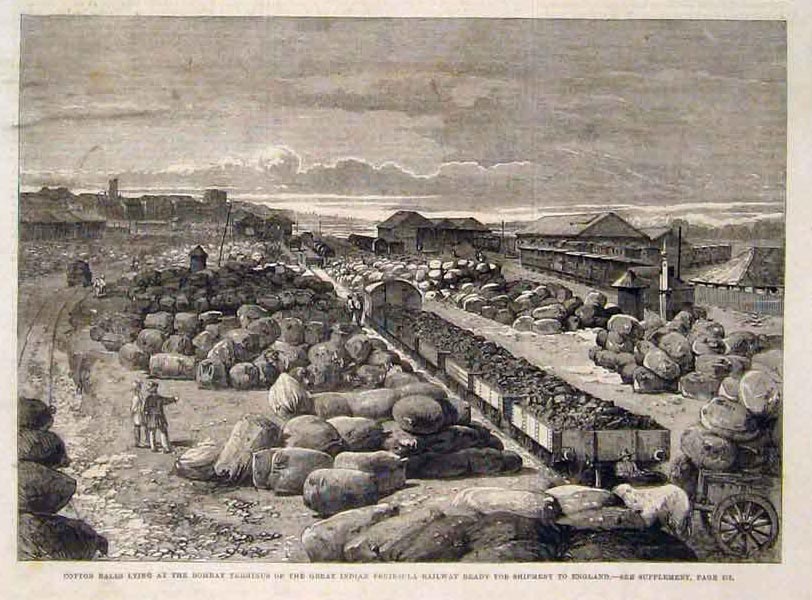
Cotton bales lying at the
Bombay Terminus of the
Great Indian Peninsular Railway
ready for shipment to England
Little is known of Stephenson’s personal life. His railway dream sent him to various places just as it would his contemporary, John Chapman, the man behind the Great Indian Peninsular Railways. The GIPR’s line from Bombay to Thane would be India’s first railroad in April 1853. Chapman was as multi-faceted as Stephenson, but unlike Stephenson, he also had radical political views. Chapman’s fascination with the railways followed his inventive work first on the Hansom cab, and then the airplane, all in the 1840s.

The Hansom cab, a ubiquitous feature of London’s streets, was first an awkwardly designed vehicle. Chapman’s inventiveness led to his substituting smaller wheels for the old ones that had made the vehicle stand too high. The driver’s seat placed higher and behind the passenger carriage allowed him to monitor passengers.

These cabs were a success but in 1841, he left following disagreements, a feature that was to recur often in his life.

Chapman moved on to the concept of a steam-driven “aerial carriage” designed by William Henson and a colleague. Chapman devised a whirling arm instrument to test the movement of air past solid objects. The three of them developed another model, with wider wings and also running on steam, but this never took off, literally, thus scaring away investors.

All this happened in the early 1840s, nearly six decades before the Wright Brothers made their maiden flight at Kitty Hawk in 1901. By then, Chapman was already drawing up plans for a railway line that would stretch 2,100 km from Bombay to a port on India’s east coast, crossing the rich cotton-growing regions along the way. Chapman himself undertook these surveys in difficult terrain. Following the EIC’s readiness to negotiate, Chapman and a few others set up the Great Indian Peninsular Railway, as a joint-stock company. Chapman, though, was soon forced out of the GIPR. He wanted a suitable position and salary but was dismissed, receiving meagre compensation for his work. In 1854, aged 53, he died from the cholera he had somehow contracted.

Chapman was ahead of his time. On the one hand he spoke for British interests that would benefit from railway construction projects, and on the other, he was against Britain’s “right to rule” over several million Indians. At a time, when shipping was considered a more promising venture, and railways in the Oriental world was deemed too risky, Stephenson’s and Chapman’s efforts paid off. Their own lives remain undocumented and unsung, but in a matter of decades, the Indian railway system was to become one of the largest in the world.


Friday, August 17, 2012

US and India - Moving closer


Relations between India and the United States seem to be going from strength to strength if high-level visits and joint statements are anything to go by. In recent weeks, the U.S. Secretary of State and the Secretary of Defence were in India. This was followed by the third U.S.-India Strategic Dialogue in Washington in the second week of June. The Strategic Dialogue, now an annual event, is a reflection of the extremely close ties that have developed between the two sides since the signing of the landmark nuclear agreement in 2008. External Affairs Minister S.M. Krishna led India’s high-level ministerial delegation to the Strategic Dialogue. Indian officials said that a gamut of issues were up for discussion, ranging from education to the promotion of democracy.

The main purpose of the Strategic Dialogue was to further enhance military and strategic ties between the two countries. Nancy Powell, the U.S. Ambassador designate to India, said that the U.S. expected to sell $8 billion worth of arms to India in the coming years. As the U.S. “pivots” militarily to the Asia Pacific, an important role is being assigned to India. Defence Secretary Leon Panetta described India as the “linchpin” in the American strategy of rebalancing towards the Asia Pacific.

At the Shangri-La meet in Singapore in early June, which was attended by Panetta and Indian Defence Minister A.K. Antony, both sides expressed a similarity of views. Both Panetta and Antony stressed the freedom of navigation in the Asia-Pacific region. China, embroiled in territorial disputes with its pro-U.S. neighbours, suspects that the new U.S. strategy is to convert the South China Sea into a U.S. lake and control key choke points such as the Malacca Straits, through which most of the oil it imports is transported.

American waiver

But what grabbed international headlines was the American decision not to penalise India and close U.S. allies such as Japan, South Korea and Turkey for continuing to import oil from Iran despite the Washington-imposed sanctions on that country. The decision was announced by Secretary of State Hillary Clinton just before the start of the Strategic Dialogue. She said the countries were being granted waivers from financial sanctions for “significantly reducing” their oil imports from Iran. Hillary Clinton said the announcement underscored the success of the Obama administration’s sanctions policy against Iran.

Since the Obama administration’s draconian sanctions against Iran, India significantly scaled down its economic ties with Iran. From being one of India’s biggest suppliers of crude, Iran is now in the third place, after Saudi Arabia and Iraq. In the third week of June, the U.S. State Department, however, clarified that the waiver was valid only for a month. The Obama administration will continue to keep a strict watch over India’s dealings with Iran.

China, along with Singapore, was among the countries not given an exemption. China imports a fifth of its oil from Iran. This oil is blended in Singapore’s refineries. The U.S. has only threatened sanctions against China, but given the interdependent nature of economic relations between the U.S. and China and the perilous nature of the world economy, it is unlikely that the U.S. will take action against the Chinese banking sector. Singapore is a close political and military ally of the U.S., besides being a key international trading entrepot.

Indian officials insisted that they did not ask for an American waiver and claimed that U.S. pressure had very little to do with the sharp reduction of import of oil from Iran. They claimed that the decision to look for oil from other countries was dictated by strategic calculations and market forces.

Trilateral talks

The second important development was the signing of an agreement between the U.S. and India to hold regular trilateral talks involving Afghanistan. For some time U.S. officials have wanted India to play a bigger role in the training of Afghan security forces as American military forces prepare to leave the country in 2014. Both the U.S. and India already have separate strategic agreements with Afghanistan.

According to reports appearing in the American media, it was the sharp deterioration of the U.S’ ties with Pakistan that prompted the Obama administration to rope in India. The U.S. evidently hopes that India will act as a counterweight to Pakistan in the post-2014 scenario in Afghanistan.
On June 14, Pakistan Prime Minister Yusuf Raza Gilani said that the government of Afghanistan was his country’s “most important partner”. Pakistan’s worst-case scenario is an increased Indian footprint in Afghanistan, which it considers its backyard. Until 2010, the U.S., on Pakistan’s request, had agreed to keep India out of conferences involving Afghanistan’s immediate neighbours. With relations between Washington and Islamabad going downhill since then, New Delhi’s role in Afghanistan was given more importance by the Obama administration. At the Strategic Dialogue, the role of Pakistan in Afghanistan was disparaged, with U.S. officials highlighting Islamabad’s role in harbouring and supporting terrorists.

The joint statement issued after the conclusion of the dialogue “reiterated that success in Afghanistan and regional and global security require elimination of safe havens and infrastructure for terrorism and violent extremism in Afghanistan and Pakistan”. In 2011, India was invited to a conference in Turkey attended by Afghanistan’s neighbours.

New Delhi is also hosting, in late June, an international conference whose objective is to encourage investments in Afghanistan. Pakistan has been given an invitation. Speaking in Washington, S.M. Krishna said the new agreement on Afghanistan had a security component. “Security would certainly form an important segment,” he told the media.

Panetta, during his recent visit to New Delhi, raised the issue of increased Indian involvement in Afghanistan. In a speech delivered at the Institute of Defence Studies and Analyses (IDSA), he stressed the need to “further deepen” the military relationship between the two countries. He declared that the two countries had “opened a new chapter” in their relationship and expressed his confidence that the new relationship would “become more strategic, more practical and more collaborative”.

India has been involved in infrastructure projects in Afghanistan and has given $2 billion as development aid to the war-ravaged country. India has been very supportive of the U.S. occupation of Afghanistan and was initially apprehensive about the consequences of the American troop withdrawal from the country.

During his visit to the subcontinent, Panetta harped on the point that his country’s patience with Pakistan was fast running out. The Defence Secretary was not at all apologetic about the drone strikes that the U.S. had unleashed on the hapless residents of Afghanistan and Pakistan. New Delhi seems prepared to play along with Washington to an extent, but Indian officials insist that there is no question of any physical deployment of troops in Afghanistan after the withdrawal of the Western forces.

Other countries, too, are keen to play a big role in Afghanistan after 2014. At the Shanghai Cooperation Organisation (SCO) summit in June, member-countries pledged to play a bigger role in Afghanistan. Chinese President Hu Jintao, who hosted the summit in Beijing, said the SCO would play a “bigger role in the peaceful reconstruction of Afghanistan”. Afghan President Hamid Karzai, who was present at the summit, said China would “play a very significant role in bringing Afghanistan and Pakistan together” to jointly fight the war against terror and extremism.

The ‘India card’

Robert Grenier, a retired senior official of the Central Intelligence Agency (CIA) and an expert on South Asia, wrote that Panetta’s “gambit in New Delhi is merely a new form of coercion against Pakistan”. Grenier observed that America’s strategic relationships with Israel and India “have more in common than is often appreciated”. The U.S., he said, was cautious of the practical use to which its alliance with Israel had been put and it should likewise exercise great caution in playing the “India card” against Pakistan.

Panetta, during his visit to India, was careful to avoid discussing controversial issues such as the Logistic Support Agreement (LSA), the Communications Interoperability and Security Memorandum Agreement (CISMOA) and the Basic Exchange and Cooperation Agreement for Geo-Spatial Cooperation (BECA). The LSA allows the reciprocal use of maintenance, servicing and communications, among other things.

On previous high-profile visits, U.S. officials tried to pressure India into signing these agreements. America’s close partners have all signed these agreements. India has been saying that the agreements will jeopardise its strategic independence and imperil operational autonomy while operating American-supplied military equipment.

Panetta said in New Delhi that signing these agreements was unnecessary. “Not signing these agreements is no barrier to further military relations,” he said. New Delhi has also so far refused to sign the “end users” agreement, which allows the U.S. to inspect the weaponry it has sold to India.

Panetta said the U.S. was firmly committed to selling the best defence weaponry to India. “Over the long term we will transition our defence trade beyond the buyer-seller relationship to substantial co-production and eventually high technology joint research and development,” Panetta said.

India has conducted the largest number of military joint exercises with the U.S. since 2001 to ensure “functional interoperability” between the two armies. They have jointly conducted counter-insurgency exercises in sensitive areas such as Kashmir and the north-eastern region of the country. Indeed, the military embrace of the two countries is getting tighter by the day.


Source: 

http://www.frontlineonnet.com/fl2913/stories/20120713291305800.htm

Monday, July 23, 2012

India in Central Asia

As negotiations for the withdrawal of international security forces in Afghanistan by 2014 gather pace, India has decided to revive its only overseas military base in Farkhor, Tajikistan. Officials from the Ministry of External Affairs will travel there next month to finalise arrangements, following which Tajik President Emomali Rakhmon is expected to visit India in September.

The revival of the Farkhor airbase and the upgrading of the military hospital on its premises, where former Northern Alliance leader and ‘Lion of Panjshir’ Ahmed Shah Massoud was treated for his fatal injuries from the suicide bomb attack on September 9, 2011 — two days before the September 11 incidents in America — is a crucial link to India’s revamped Connect Central Asia policy unveiled in June at a dialogue forum in Bishkek, Kyrgyzstan, by Minister of State for External Affairs E. Ahamed.

With India’s risk-averse corporate community unwilling to follow the government’s lead in establishing a firmer footprint in the region since the break-up of the Soviet Union 20 years ago, Delhi has come to the conclusion that it must use its own muscle to project its strategic presence in Central Asia.

Much has already been written about this hydrocarbon-rich region and how China, Russia and U.S.-dominated western consortiums have laid networks of oil-and-gas pipelines to service their own markets. China, especially, has used energy supplies from Turkmenistan and Kazakhstan to fuel its relentless rise as an economic power – but the truth is that none of these benignly authoritarian regimes are complaining.

Kazakhstan has leveraged the sale of its energy resources to become, with a per-capita GDP of $13,000 in purchasing power parity terms, the richest state in all of Central Asia. Astana, a windy city in the Siberian steppe, was transformed into the capital in 1997 by a diktat of its President, Nursultan Nazarbayev, and today its skyline is littered with glass-and-gold-domed buildings. Divided by a river — the Ishim — that runs through the town, Astana has a Left Bank and a Right Bank, besides a glass-and-concrete pramid that doubles up as an exhibition space and a concert hall that looks like the Parthenon. Outsiders may wonder at the copycat Disneyland, but the Kazakhs are certainly not complaining.

Mr. Nazarbayev is hardly a latter-day version of Mohammed bin Tughlaq — who whimsically moved his capital from Delhi to the Deccan in the 14th century and then had to move it back — although he completely controls the state apparatus. Mr. Nazarbayev decided, when he came to Delhi for the Republic Day festivities in 2009, that 25 per cent of the Satpayev oil block will be given to OVL. Both China’s CNOOC and U.S.’ Chevron already had their share of Kazakh energy spoils and Mr. Nazarbayev wanted to expand options. (His wife is also believed to have been a follower of the Sathya Sai Baba, thereby adding to the India connection.)

That’s the general perception of India in Central Asia — that it is a rising regional power, not quite in the league of China but interesting to behold because of its enormous market, its incredible culture, its singular capacity to innovate and even its fractious democracy. India is not a priority, but it cannot be ignored.

Interestingly enough, a mirror-perception about Central Asia persists among the Indian elite. The land of Babur (Uzbekistan) and Bairam Khan (Turkmenistan) and Mirza Hiadar Dughlati (Kazakhstan) and Bedil (Tajikistan) is still cloaked in the mist of history and its combined 65 million population has largely been ignored. Although most Central Asian capitals are a couple of hours away from Delhi by air, the lack of connectivity by rail or road means that serious business interest is almost absent.

So China-Central Asia trade tips the scales at $29 billion and U.S.-Central Asia trade touches $26 billion while India-Central Asia trade stands at only $500 million (excluding investment in the Satpayev oil block and the Turkmenistan-Afghanistan-Pakistan-India, or TAPI, gas pipeline, which will take five years to fructify). That’s why India must do things differently if it has to return to Central Asia.

Alongside the revival of the Farkhor airbase in Tajikistan and the upgrading of the defence relationship with Dushanbe, private hospital chains like Max are being persuaded to set up trauma centres — if not hospitals — in key cities all over the region. Plans are afoot to start an India-Central Asia university in Bishkek. An e-information technology network is on the cards, just like in key countries in Africa. Meanwhile, talks are on with a Russian channel with a treasure trove of Hindi films, perfectly dubbed into Russian, to expand broadcast all over Central Asia. From Raj Kapoor to Shahrukh Khan, Bollywood is still the key to open hearts and minds in Central Asia.

With the western withdrawal from Afghanistan on the cards, the Central Asian pot will boil further. India lost the opportunity to drive deep into the region when the Soviet Union collapsed 20 years, but it’s now getting a second chance.

Hopefully Delhi won’t mess it up again.

Friday, July 20, 2012

Not missing the wood for the gold

In ancient Indian chronicles, Myanmar was known as Suvarnabhumi or the “golden land”' already famous for its boundless riches. Its fabled wealth of gold, silver, precious gems and much more, attracted invaders and traders from around the world. There is now a 21st century version of a “gold rush” beginning to take hold as Myanmar opens its doors to the world. Nothing demonstrates this more starkly than the U.S. government decision to lift the prohibition on new American investment in Myanmar including doing business with state owned oil companies. This is despite the public plea from the leader of the country’s democracy movement, Aung San Suu Kyi, that such deals should be avoided until these entities embrace transparent practices and remove corruption.

Lure of opportunities

At the U.S.-Asean meeting at Siem Reap, Cambodia, which concluded on July 13, U.S. Secretary of State Hillary Clinton had her second meeting with Myanmar President Thein Sein and the two later addressed the strong business contingent accompanying Ms Clinton. It was announced that a 70-member U.S. business delegation would soon visit Myanmar to explore trade and investment opportunities. Other western and Asian states are likely to follow. Clearly the lure of commercial opportunities and profit has triumphed over the hitherto careful alignment with the pace set by Ms Suu Kyi. As this trend gains strength, Ms Suu Kyi will lose one of the more potent bargaining chips she has in dealing with the military dominated government, that is her ability to calibrate the dismantling of western sanctions that have been in place for the past two-and-a-half decades. This may well lead to opinion in India that we, too, should join this rush or face further marginalisation in a key neighbouring country.

This may not be the best strategy to pursue.

In Siem Reap, Mr. Thein Sein spelt out three reforms which were on the top of his agenda. The first, he said, was to consolidate democracy, build strong democratic institutions and restore the fundamental rights of people, including the freedom of speech and assembly. The second was to achieve lasting peace in the country by reaching out to the various ethnic groups and bringing them into the national mainstream. And the third was to transform an essentially centralised economy into a market oriented one, open to foreign investment and commercial exchanges. In each of these areas India can offer itself as a significant and long-term partner, relevant to Myanmar’s own identified priority areas. India should avoid falling victim to a herd mentality but instead focus on establishing a long-term and sustainable presence in the country, encompassing political, security and economic fields. Myanmar may currently be the flavour of the month. For India, it must remain on the menu as a key foreign policy and security challenge in a rapidly changing environment.

Why is Myanmar important to India?

Here is a neighbour with whom we share a 1,600 km long land boundary. Four of our sensitive northeastern States — Arunachal Pradesh, Nagaland, Manipur and Mizoram — lie along this border. In dealing with the complex security situation prevailing in this region, Myanmar's cooperation is often critical. The two countries also share the strategic waters of the Bay of Bengal. Any hostile or inimical presence along the Myanmarese coast or on its off-shore islands facing India would be of great concern. Myanmar is also critical to the success of India’s Look East policy. It is India’s gateway to Asean and a transit country for trade and economic exchanges with southern China. The sub-regional organisation of BIMSTEC, which straddles both South and South-East Asia, gives a pivotal role to Myanmar as a regional hub. India has long standing historical, cultural and religious links with Myanmar which underpin a broad-based relationship. There are cross-border ethnic links, too, with Naga and Mizo tribes inhabiting both sides of the India-Myanmar border. The prospects for an enhanced economic partnership, in particular, in the energy sector will add to this substantive and comprehensive relationship, but only as a significant component, not as a singular rationale for engagement.

Significant presence

India’s interests require a significant, but not a dominant presence in Myanmar. Countervailing China’s hitherto overweening presence in Myanmar could not be an Indian preoccupation alone. Our interests are served as Myanmar’s foreign relations become more diversified, lowering the salience of Chinese influence.

In this context, Prime Minister Manmohan Singh’s visit to Myanmar in the last week of May was a major initiative. India tried to align itself with the priorities set by the Myanmar leadership itself, including Ms Suu Kyi. The Prime Minister offered Indian expertise and support in the setting up of strong democratic institutions and build capacity in parliamentary practice and procedures. India’s own experience in managing a multi-ethnic, multicultural and plural democracy is a useful point of reference as Myanmar seeks to pursue reconciliation and accommodation with its several ethnic minorities. On the economic side, the visit resulted in a number of important agreements, the most notable being the extension of a $500 million credit line to finance several projects. The two sides agreed to launch a Border Area Development Programme, which will seek to establish development corridors along the ambitious cross-border transport links that are being put in place. This will be of considerable relevance to the development of our own northeast.

The Prime Minister met Ms Suu Kyi in Yangon and extended her an invitation to visit India which she accepted. This will take place later this year. The meeting was warm and friendly with both sides eager to dispel the sense of disappointment which had resulted from India’s engagement with the Myanmar generals while she was languishing under house arrest.

Ms Suu Kyi focussed on the development challenges facing her country, particularly the alleviation of poverty among her people and was keenly interested in India’s own experience in this regard. As member of Parliament, she has declared her intention to work hard for the betterment of the lives of people, promote inter-ethnic harmony and national reconciliation and contribute to the consolidation of democracy in her country. She recognises that the way ahead is full of risks and uncertainties. One cannot say that the reform process is irreversible. Ms Suu Kyi has also been careful in her statements on the ethnic issue, which could erupt in dangerous ways. The Kachin insurgency lingers on and the recent violence in the Rakhine province involving the Rohingyas has confronted her with difficult political challenges which are not easy to resolve. In the initiatives that Ms Suu Kyi may adopt to take a leadership role in addressing these challenges, India could be a friendly and supportive partner.

India should, therefore, avoid being distracted by the gold rush and remain focussed on the long term. It has a unique opportunity to align itself with the priorities set by the leaders of Myanmar and make its own contribution to enabling a successful political and economic transition in a strategic neighbouring country.

This is a more sensible way of ensuring India’s political, economic and security interests in its strategic neighbourhood than joining the unseemly grab for resources that appears to have gripped Myanmar’s erstwhile detractors.

Source:- http://www.thehindu.com/todays-paper/tp-opinion/article3655681.ece