Monday, April 29, 2013

In India, No “Statistics” for the Statistician


The Ministry of Statistics and Programme Implementation does a silent job of collecting data on various fields from the entire country. Some of the data have predominant significance in an individual’s life - like that for Consumer Price Index [Urban] where data is taken on the selling price of certain goods [pre-fixed]. The concerned data help in determining the Dearness Allowance (DA) of government employees. Some other data which also gets collected may not be of direct use to individuals, but in long term, it helps in policy formulation and taking important decisions relating to the holistic development of the country. These include the area enumeration of different villages in India, getting idea regarding the amount of crop yield from a particular field for all seasons – viz. Rabi, Kharif and Jayat Rabi, socio-economic survey, urban frame survey, Annual Survey of Industries, among others. All these surveys are done by the Field Operation Division of National Sample Survey Office under the aforementioned Ministry. The surveys are carried out simultaneously by the different Regional and Sub-Regional Offices all over India.

One of the major problems that the investigators face is the lack of response since there is no law binding the informant for supplying information. Suppose, let’s take the experience of a crop-cutting survey. Now any state of India has hundreds of villages and it is the responsibility of Field operations Division (FOD), Faridabad to allot certain villages for each round in such a manner such that after every five years, the same village gets repeated again. A tedious task no doubt, given the size of most of the Indian states. But then one may sideline this as a routine work, saying that they are just repeating the procedures which they are following from time immemorial. Next job is to pick up a field through random number. Suppose village A in state X got selected and there are 1000 plots in which crop is being cultivated in that village, then if the random number being allotted is 700, then choose the 700th plot for your study. If random number allotted is 1500, divide 1500 by 1000 and the remainder i.e. 500 will give you the required plot number. Its statistics so far – probably no big deal, and can be done by sitting at the village Patwari’s office.

Even if the chosen plot does not grow the required crop, say wheat about which information is needed - then go for the next field, not that complicated yet. But now surfaces the typical problems. One fine morning you happily go to the field and ask the farmer for his help. The poor Indian farmer who used to be very naïve would previously agree to help unconditionally - making life easier for the investigator. But now the farmer, who has also started feeling that he has missed his share of pie for quite some time asks the question-

              mujhe kya milnewala hain?

And well, the investigator knows the answer only too well. Rs 50, may be, and that too after a year. For that the farmer has now to cut the crop in the investigator’s presence, manually thresh it and give the exact measurement to the investigator. The most difficult is the crop cutting part - it is not the usual crop cutting that the farmer does at regular interval of time. You take a square of side 5m or an equilateral triangle of the same side length or a circle with radius 5m, that too after measuring the plot by actual walking, then subtracting 7 from both length and breadth and then considering random numbers. Then you have to separate the crop of that small area and dry it up. After say 8-9 days, the investigator once again goes. This time that crop should be manually threshed - even a difference of 100 gm can now bring lots of changes in the estimate of the total crop yield of that particular crop of the country. But what has the farmer got to gain from all these statistical jargons?

He gives time for crop cutting - but he has nothing to bind him to that date. If he feels he may cut it before or might cut it after - depending on his experience regarding the crop as well as weather condition. But the poor investigator has nothing to do - he has to get the information and that too for the plot chosen, he cannot force the farmer for any of the things, but cannot also return empty-handed. Even if the farmer refuses for manual threshing - the investigator might as well has to thresh the crop on his own, since his job is to get the data and he knows that the data would be needed to calculate the national figure. Now this particular yield rate will give an estimate of the amount of that particular crop grown in that season in the entire country. And then if any of the data goes wrong - the entire nation, powered by the now 24X7 news channels will attack the statistical machinery of the country and start throwing questions like how can there be such under production? How can China do it and not India? But does the process look very simple?

The process of data collection is not very complicated apparently. The Sample Design and Research Division (SDRD) of NSSO located in Kolkata is carrying out the research as to what are the items relevant these days on which the data should be collected. The Industrial Statistics (IS) wing of the Central Statistical office (CSO) has left no stone unturned in identifying the different industries in the country, the varied raw materials needed for the output of the various products that rule the market; and the FOD ensures that with the inadequate manpower it has, it must collect data for all the proposed schemes that will help in policy making. Now-a-days, the NSSO collects data for six years in a decade and has left four years for different central ministries who might request this particular department to collect data as per their requirement. Thus it is quite evident how much importance this particular ministry has.

But how much awareness do the common people have with regard to this is a big question. The people also feel that the time in which they are providing the data is simply meaningless since they are not going to gain anything from the data they provide and there is no law binding on them which compels them to provide the data.

At least, apparently no one sees any monetary gain in this.

Hence even if a person having three cars within his residential complex demands that his monthly per-capita expenditure is Rs 3000 for five persons, no one can challenge his data and no one can compel him to give the actual data. Similarly for the farmer, first of all, demarking the area with the precision as demanded by a statistician is itself a herculean job. Then that much crop needs to be separated and should be threshed separately manually in front of the Superintendent Officer and the village Patwari. Thesedays, on request from the Ministry of Commerce, the NSSO is collecting data on Wholesale Price Index Number. The Commerce Ministry has done everything - right from fixing the commodity basket at 2004-05 base to designing the schedule and selecting the quotations and the units.

What NSSO does is to go to the respective units, that too every month and request the people to fill up the schedule and upload it in the web portal. The Commerce Ministry has provided each unit with username and password and given a master password to the ROs for continuous monitoring. But however much they have tried to make life smooth; people would not do the job and give thousands of excuses for not doing it - reason being nothing is forcing them to provide the data.

But suppose if the Income tax Department demands certain data from the same unit - they’ll postpone all of their jobs at hand and start preparation for providing data to the IT Department. Reason? Well, the IT Department has power which NSSO doesn’t have. The entire work of NSSO is persuasion based. No one has any power to force the people to provide information -however useful the information might be. The only exception is in the Annual Survey of Industries where non-responses is comparatively less as people are empowered with the Statistical Act 2008. But in most of the cases, people do not have the necessary awareness. The importance that these data carry for the entire nation is something that is known only to a handful of persons who also do not have the necessary authority to make people part with the data.

Hence some sort of autonomy must be provided to the Ministry as data is the basis for everything. Instead of blaming the CSO or NSSO for some wrong figures, kindly give them the power so that data collection becomes a smoother and easier process.

--------------------------------------
The anonymous author spells out the ground realities which speak of the travails of the official statistician.


Wednesday, March 27, 2013

Born in India


When I opened my eyes, I looked at the roof and a drop of water fell on me. The tarpaulin had a hole, and smoke from the Chula almost choked my breath, my legs were weak and I felt hollow inside.  When I was five, I realized we ate just once in a day and my father drank whenever he had enough money. By the time I was seven , I was taken to sethji (wealthy employer) to work at his house. There I saw someone like me, he had more clothes than me and was heavier too. He had “khilone” (toys) and a small bed for himself. One day he was eating something wrapped in a plastic and as “mem sahib” (wife of employer) called he ran and left behind two pieces of the wrapped thing on the floor. I picked them up and looked at them and unwrapped one and placed in my mouth, sethji  seeing me shouted “chori kar raha hai” (he is stealing) and thrashed me and threw me out of the house. At home father scolded me.
As I was ten, I was rolling biddis (Indian cigarettes) and also worked at the local tea-shop. One day a traveler asked me, “ Tum school nahi jate?” (Don’t you go to school?) and I laughed and said “wo kya hota hai” (What is that?)

This is the story of Madhav. 

Well not the story of one Madhav but more than 50% of the children of India between the age of 6 and 14. We do not need the support of statistics to prove it. We would have been “the traveler” most of the times.  It is easy to question them why they don’t go to school but no one provides them any alternative. The situation is worse for the girl child if she survives the successive stages of feticide, killing and death due to malnutrition. Even if she escapes infanticide or feticide, a girl child is less likely to receive immunization, nutrition or medical treatment compared to a male child. [1] Statistics are mere indicators; the actual story will be way brutal than the worst of imaginations. Madhav was born in India, he should have thanked fortune for not being born as Madhvi. There was one-sixth chance he would have survived.

Merely enacting the RTE (Right to Education Act), or the Child Labor Act or for that matter the Juvenile Justice Act is enough. How many of the complaints at 1098 (Child helpline number) have been solved and for that matter how many children know of this number? [2] Well if it were so then being born in India would be a matter of pride not only for a selected few but for everyone.  Madhav was born in a shanty but had he been provided education at elementary level, things could have been different. The problem is justice was denied to him and in such cases children cannot find endless legal battles or for that matter childhood lost cannot be regained.

That brings us to a very pertinent question - What can be done?

Statistics : Before answering this question let me take you for a ride into some eye-opening statistics published by the honorable Government of India (Ministry of statistics and Programme Implementation):
  • As per the NFHS -3 (2005-06), nearly 11.8% children age 5-14 years works either for their own household or for somebody else.
  • The very young children (age 5-7 years), both boys and girls, are mainly doing unpaid work for someone who is not a member of their household. The older boys age 12-14 are mainly engaged in paid work or family work, whereas girls in this age group are involved mainly in household chores or family work.
  • An increase of 122.2% has been observed in cases of ‘importation of girls’ during 2010-11, and 56% of these cases reported in 2011 are from Madhya Pradesh.
  • In 2010, IMR is reported to be 47 at the national level, and varies from 51 in rural areas to 31 in urban areas.  [3]
The statistics are endless presenting nothing but a gruesome picture of our hinterland. The worst part of these situation being it is wholly a avoidable one.3/4th  of Indians were poor, spent 3/4th of their income on food but 3/4th of the children were under weight.47% of Indian children under five are categorized as moderately or severely malnourished. When on one side of the world people are weight conscious gymming and dieting there are children of India who die of malnutrition. Sadly human fat cannot be traded unlike carbon credits. [4]

Government policy: Government has done its bit too, although out of every 100 rupees spent by it a meager 3 paisa is spend on child education and programs. To say that the government has done nothing would be a gross under-assessment. For its part government has launched several programs like:
  • National nutrition policy
  • SABLA(Scheme for Empowerment of Adolescent girls)
  • IGMSY( Indira Gandhi Matritva Sahyog Yojana)
  • Sarva Shiksha Abhiyaan(SSA)
While the government boasts of a high enrollment rate of around 94% no one makes the effort of looking beyond the enrollment, a UNESCO report says just 20% of those attended schools. If the both the reports were true then the ground reality is definitely not as pleasant as the government claims. [5]

We may well celebrate the World day Against Child Labour on 12th of June every year yet the “chotu” and “munni” (generic names of children working at tea stalls and homes in India) continue to serve us. We might argue we are providing the employment but deep within we all know what he/she wants is education. For education alone could rid their family of poverty. The political will is lacking but to add to that is public sympathy. What they want is you apathy to understand their misery. We are ready with our argument,” In this fast paced life who has the time!!” But then again it is for this reason you had voted and laid the foundation of democracy. Your job didn’t end. If they are not listening, it’s your duty to make them listen otherwise democracy loses its meaning. 

A beginning: Although a welfare state, we still cannot hold the government responsible for all our problems. There are steps which even we should take at our level. We can take inspiration from the case of Mrs  Mukti Gupta. More than a decade ago, when Mukti encountered yet another urchin knuckling on her air-conditioned car pane with ‘Didi, teen din se kuch khaya nahin’, she didn’t respond with a dismissive ‘Maaf karo’. She went home and proposed, ‘Can we set up a school for them?’ When people like you and me indicated that buses are for commuting in and not for running schools, Mukti stripped off the seats to create a clean 175sq ft sitting facility with desks and a ‘wall’ plasma TV for audio-visual learning. When someone suggested that urchin-entrepreneurs are too busy scraping a living to go to school, Mukti proposed that her bus school would teach the kids a vocation for immediate monetization and provide them with fruits, so that once they saw this as financially and nutritionally rewarding, they would prefer to come back (and only then be gradually drawn into the teaching programme).

The example of Mrs Mukti is not only for us but also for the government to follow. The government has to teach them something more than elementary education. If we have to prevent them from working, besides education we need to provide them hand-in-hand skills training which will not leave them employed in hazardous industries, bidi-making, theft and other immoral acts. What we need is a trained and educated individual who doesn’t go unemployed at the end of his childhood such that he is able to live his childhood and satisfy the income problem of his family, which will in turn make people send their children to schools. And there should be a pro-bias for the girl child in the form of compulsory scholarship for higher education in case of meritorious students and some form of post-marriage knowledge which will go a long way in curbing the evil problem of child marriage in India which is not there in books but the harsh reality faced by people. [6]

The future: May be a decade later a Madhav will again be born in India in a shanty but will not be employed by sethji or will steal a chocolate but will be studying in a school and by 20 have a mobile repairing shop and support his family. A madhvi will be born too with higher chances of survival, will go to school and learn weaving and work at a garment center and help her father in raising her siblings, and will not be a burden to marry off but an asset to part with. She will then marry at an age when she knows the meaning of marriage. They will then be if not privileged at least happy to have been given an opportunity rather than the Madhav of today who had no opportunity.  Down the lane, less of people might be inclined to join insurgency operations or riots because they will know the true meaning of education. India will change from being a country of huge unskilled labour to a country of buyers. In the words of our Hon’bl President Shri  Pranab Mukherjee –

In my view, education is the true alchemy that can bring India its next golden age.

References:
  1. http://america.cry.org/site/know_us/cry_america_and_child_rights/statistics_underprivileged_chi.html
  2. http://www.indianchild.com/childlaws/child-laws-in-india.htm
  3. http://mospi.nic.in/Mospi_New/upload/Children_in_India_2012.pdf
  4. Yojana Magazine(November 2012)
  5. Kurukshetra Magazine(September 2012)
  6. http://www.telegraphindia.com/1130220/jsp/calcutta/story_16583151.jsp#.USTW3R2D-KI
---------------------------------------------------
Rajan Agarwal was Born In India and takes keen interest in the issues that plague his country. You may write to him at indianpolicy2010@gmail.com

Wednesday, February 20, 2013

Health in India - field notes


India - the second most populous country in the world fairs poorly when ranked as per the Human Development Index (HDI). A major contribution for this poor ranking depends chiefly on the health sector which plays a crucial role in determining the HDI. The onus, in some way, falls on the non-availability of health facility to majority of the Indians. India has one of the highest Infant Mortality Rates (IMR) and Maternal Mortality Rates (MMR) in the world. The area of concern still remains that the country which fare poorly in terms of economic growth with respect to India like Bangladesh has a better strategy to combat IMR and MMR as compared to India !!

In order to resolve the burning problem, the Ministry of Health and Family Welfare started off the National Rural Health Mission (NRHM) in 2005. This ambitious mission was aimed to improve the health care delivery system across rural India. Certain benefits were announced under the Janani Suraksha Yojana (JSY) where the poor pregnant woman would get cash for institutional delivery and also for neo-natal care. Accredited Social Health Activists (ASHA) workers are appointed in the villages who undergo regular training and act as a bridge between the poor women and the government. They are supposed to take additional care of the adolescent girls and provide them with iron tablets. Also the Auxiliary Nurse Midwife (ANM) is present to ensure optimum level of health in the villages.

After the birth of the child, it is supposed to be given proper care under the Anganwadi Scheme launched under the Integrated Child Development Services (ICDS) upto the age of 6 years. Proper food is also supposed to be given and annual check-up of the infants are to be done by pediatricians.

However even with all such advantages, the benefits often do not trickle to the people for whom it is intended. 

Real life example from a village visit

As a part of a training module, we had to go to different villages of the country to sensitize ourselves to the problems faced by rural India. The village were I was sent was Jirona, in the Umri Taluka of Nanded district of the state
Maharashtra. Although Nanded is a prosperous town owing to the holy connection that it has with the Sikhs, the village which is approximately 270 km away from the main town neither did nor present a very cheerful view. 

Doctors, the villagers pointed out were alien to them. The ANM worker who had the responsibility to look after that village and the adjacent village of Somthana, located 2 km away, would come once in a blue moon. The ASHA worker was present in the village though; but people could hardly rely on her.
They felt that going to the Taluka and getting treated by the doctor over there is far better than getting treated by her, even if that means they have to visit the doctor in his private clinic. So much so, she did not know how to see a thermometer, even though she gets training for that as well.

There exists a high correlation between good sanitation and good health. As the first Prime Minister of independent India Jawaharlal Nehru said:

The day when all the houses in India will have a bathroom, I’ll know that India has really progressed.” 

Well, even after six decades of freedom, sanitation still remains a far cry for greater part of India and the awareness regarding hygiene and sanitation is still very low. 

In the adjacent taluka of Bhokar in the same district, open defecation was found rampant in majority of the villages.

This writing took its concrete shape after the news was published that UPA Chairperson Mrs Sonia Gandhi launched Rashtriya Bal Swastha Karyakram on 6th February, 2013 at Palghar town in Thane district of Maharashtra. Thane is approximately 548 km away from Nanded. 

The main idea of this Karyakram is to provide safety and security to the children upto 18 years of age. However, the question remains if the basic amenities that were being provided are still unavailable to a major portion of the people, considering the district of Nanded as a representative sample unit, then how the new scheme can be implemented effectively?

Thus, just flagging off new programmes is not an answer to the growing issues of the burning problems like high MMR and IMR. Effectively spreading the programmes and implementing them remains a challenge - solving which will help in the holistic growth of India. Also the urban slums need to be taken care of, as more and more people who are migrating to the city are forced to live in the slums in very unhygienic conditions. Then only we can boast of a shining and growing India.

-----------------------------
P.S. The author desires to remain anonymous. However, you may post your comment(s) freely at this forum !

Sunday, February 17, 2013

Indus Valley Civilization in 2013?


Whenever I see the streets of Kolkata…I wonder where the people from Indus valley civilization have vanished” - by a polymath I look up to.

Well this scenario might not be of Kolkata alone; several cities will unfortunately and helplessly give it company. What significance does the Indus Valley Civilization, a civilization of c.2500 BC hold in the 21st century? Is it something for the historians to analyze or for us to gape with mouths open during our standard 8th to 10th curricula of History? Well by the end of this passage we might be able to form an opinion for ourselves.

The famous historians as well as people writing about ancient history of India have debated mostly on the cause of decline of the magnanimous “Indus Valley civilization (IVC)”. Well there are more important artifacts and monuments found while excavation which have the potential to put the modern planning to shame. But the question arises why did we excavate in the first place?

The growing administrative responsibilities of the English East India Company , especially after 1765 when Mughals granted it the right to collect revenues and administer civil justice in Bengal, made it necessary for its officers to gain familiarity with the laws, habits, customs and history of the Indian people.[1] But the discovery of IVC was more accidental than planned. In 1856, General Alexander Cunningham, later director general of the archaeological survey of northern India, visited Harappa where the British engineers John and William Brunton were laying the East Indian Railway Company line connecting the cities of Karachi and Lahore. They were told of an ancient ruined city near the lines, called Brahminabad.

Visiting the city, he found it full of hard well-burnt bricks, and, "convinced that there was a grand quarry for the ballast I wanted", the city of Brahminabad was reduced to ballast. Half a century later, in 1912, that more Harappan seals were discovered by J. Fleet, prompting an excavation campaign under Sir John Hubert Marshall in 1921–22 and resulting in the discovery of the civilization at Harappa by Sir John Marshall, Rai Bahadur Daya Ram Sahni and Madho Sarup Vats, and at Mohenjo-daro by Rakhal Das Banerjee, E. J. H. MacKay, and Sir John Marshall. [2]

So what was actually discovered which led historians to conclude that it was a flourishing urban civilization according to current definition standards. Some authors have gone on to prove extra-terrestrial influence and possession of atomic weapons, though these claims were not proved conclusively but could not be cast aside outright. [3] But there were conclusive signs of an urban civilization which were agreed by all. The millions of tons of wheat rotting because India ran out of warehouse space to hold another bumper crop illustrate a core problem of the nation’s food crisis: India can grow plenty of food but cannot store or transport it well enough to nourish its 1.2 billion people. Warehouses are overflowing and huge quantities of wheat and rice are stored in fields under tarpaulins and thin plastic sheets, risking decay. [4] The above is a problem in an urban civilization where majority don’t do cultivation and food grains need to be stored, but grains did not rot in the IVC, although they did not have plastic sheets to cover them, nor did they have railways to transport them, so what did they have ?

The “great granary” is among the well-known buildings at Harappa and consisted of a series of brick platforms on which stood two rows of six granaries. As a structure it is particularly impressive, running 45.71 m long, 22.86 m wide and 4.6 m high. This gave the granary an astounding 4780 cubic meters of space. The granary was divided into 27 compartments in three rows. The granary was well ventilated and it was possible to fill grain in from outside. All this for an estimated population of 40000 per city which is nothing compared to the scenario of today.[5]

India might boast of having the second largest road network in the world but barely 50% are paved roads. According to the definition of the classes of Highways, Standard Double Lane (SDL) : Surfaced roads having clear carriageway width between 7.0 M and below 10.5 M. And now what percent of our roads are highways, barely one percent. And going back to the IVC what do we find. The main streets, some more than 9 m wide and laid out on a grid plan. They were quite straight and intersected each other at right angles, thus dividing the city into rectangular blocks. All this when there were bullock carts to travel; thinking of the present scenario will make them construct highways next to our houses!!![6]

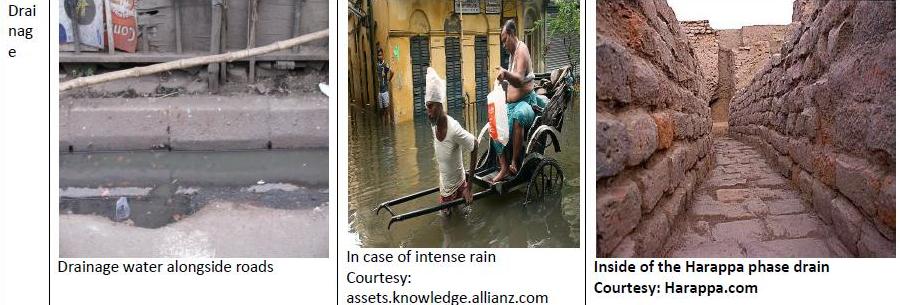
We have dustbins in our house but what percentage of India has it, well I would put that figure to less than 2%. It should not surprise us because 54% of India defecates in the open and 30% of the rural households have latrines, of which 64% have drainage. And these are official figures.[7] We must have sensed the stench coming out of open drains and culverts, probably our ancestors did not like it as much as we do. The streets and buildings of Harappa were provided with drains made of burnt bricks. The houses were equipped with rubbish-bins and attached bathrooms and occasionally with a privy on the ground or upper floor. The bathrooms were connected by drains with sewers under the main streets. The drains were either covered with bricks or stone slabs. It definitely makes us think.

In this age of interior designing and hiring architects for building our houses we still have faults, sometimes we open our window to the polluted smog, the roadside garbage, possibility of people peeping in. but we will be surprised to know that the people followed a very simple practice of no windows facing the street. Those were proper brick houses having rooms.

We talk of standards of trade and goods, several international agreements have been signed. So where did this practice begin? Again we need to refer to the harppan people who began the system of seals and sealing for maintaining quality and standards. The art and craft were beautiful and constructed with basic tools know then like the chisels, knives etc. 

They started with concept of public baths having proper changing rooms which we even lack in all places in today’s era.

Their script hasn’t till date been deciphered. We never know what secrets it might contain.

The cities were built on a raised platform possibly to prevent enemy attack and protect from flood. And we still grapple with daily problems of flooding in one or the other part of India. The Khetri mines of Rajasthan used for extracting copper during those times is still one of the largest contributors of the metal in India. The large number of ports in Gujarat bears testimony to the Lothal dockyard of the IVC. Knowing all this makes a think for a moment that the ET (extra terrestrial) theory might not have been entirely false.

All said and done, coming back to my question- what is the significance of IVC in 21st century? The purpose of historical inquiry is not simply to present facts but to search for an interpretation of the past. Historians attempt to find patterns and establish meaning through the rigorous study of documents and artifacts left by people of other times and other places. Instead of spending so much on promotion of schemes like PMSNY(Pradhan Mantri Sadak Nirman Yojana), TSC(Total Sanitation Campaign), and clean India missions, if we are able to arouse in the people the passion to revive the past of the ancestors of
the human race not bound by religion, caste, creed or faith, but united by commonness of origin.

This can be realized if we could make the people a partner in the projects, not by employing them through MNREGA (Mahatma Gandhi National Rural Employment Guarantee Act), but by making them voluntary partners in the project. If the surplus could be redistributed instead of letting it rot in the open and asking people to come up with gram level or zilla level storage facilities for protection against drought in their own zilla and grams and if need be to neighboring grams at a premium paid by the government. If we could arouse nationalist passions in the people against the rule of the British then it won’t be difficult in arousing their spirits for their own development, for their own upliftment, for gaining inspiration for bringing in a sense of communal harmony and oneness. The great granaries and the wide paved streets of Harappa serve as a role model for the rural and urban areas to aim towards development and the government accelerate the process by merely acting as a facilitator. The long due problems of sanitation could be tackled by making them aware of the glorious past where people had a proper drainage system and used bathrooms. May our glorious past pave the road towards a cleaner, healthier and enriching future.

Below is a pictorial comparison of the current situation when compared with IVC:


References:

[1]. Ancient India-D.N. JHA
[2]. Wikipedia:
[5]. IGNOU BA Course material (courtesy-egyankosh.org)


-----------------------------
Rajan Agarwal has developed a keen interest in comparing ancient and modern India. You can share your views with him at indianpolicy2010@gmail.com

Tuesday, February 5, 2013

Is Africa really that dark ?


We must have often heard the term “Dark” continent being used for the African landmass. But what makes us believe that definition easily ? Well one major factor contributing towards that description is the geography and the social status of the continent. Africa is the world's second-largest and second-most-populous continent. It has 54 countries, 9 territories and three de facto states with limited recognition. Geographically speaking it is a conglomerate of deserts, mountains and dense forests.  Its northern half is primarily desert or arid, while its central and southern areas contain both savanna plains and very dense jungle (rainforest) regions.  Africa is the hottest continent on earth; dry lands and deserts comprise 60% of the entire land surface. It is also home to a variety of "jungle" animals including snakes and primates and aquatic life such as crocodiles and amphibians. Deforestation is affecting Africa at twice the world rate, according to the United Nations Environment Programme (UNEP). According to the University of Pennsylvania African Studies Center, 31% of Africa's pasture lands and 19% of its forests and woodlands are classified as degraded, and Africa is losing over four million hectares of forest every year, which is twice the average deforestation rate compared to the rest of the world. About 65% of Africa's agricultural land suffers from soil degradation. Poverty, illiteracy, malnutrition and inadequate water supply and sanitation, as well as poor health, affect a large proportion of the people who reside in the African continent.

As there are two sides of a coin, the continent also has its riches: The continent is believed to hold 90% of the world’s cobalt, 90% of its platinum, 50% of its gold, 98% of its chromium, 70% of its tantalite, 64% of its manganese and one-third of its uranium. The Democratic Republic of the Congo (DRC) has 70% of the world’s coltan, and most mobile phones in the world are made with elements refined from this mineral. The DRC also has more than 30% of the world’s diamond reserves. Guinea is the world’s largest exporter of bauxite. Slowly the darkness seems to be fading out? A similar effort by Famous geographers like David living stone and Stanley with funding from their native countries discovered several river courses, unearthing the hidden and otherwise ‘dark’ part of the globe.

History:

Gone are those days when Africa was infamous for its slave trade. Slavery had long been practiced in Africa. Between the 7th and 20th centuries, Arab slave trade took 18 million slaves from Africa via trans-Saharan and Indian Ocean routes. . As a result of industrialization, major social problems had grown in Europe: unemployment, poverty, homelessness, social displacement from rural areas, and so on. These social problems developed partly because not all people could be absorbed by the new capitalist industries. One way to resolve this problem was to acquire colonies and export this "surplus population." This led to the establishment of settler-colonies in Algeria, Tunisia, South Africa, Namibia, Angola, Mozambique, and central African areas like Zimbabwe and Zambia.

It was not until the 1930s that slavery in Africa was almost totally eliminated. Which paved the way for the second scramble for Africa via trade relations and diplomatic channels. Two countries in Asia became the forerunners of this scramble, India and China - in similar yet different ways.

Enter the Chinese Dragon:

China’s entry into Africa is characterized by ‘an aid-for-oil strategy’. The traditional model of Sino-African trade is one in which Africa exported energy and raw materials (minerals, precious stones, timber, cotton, fish products) and imported consumer goods, machine tools and textiles. Oil ranks first among Chinese imports, accounting for 60 per cent of total imports. Imports from Africa now represent 25 per cent of all China’s oil imports, and this percentage is on the increase. Sixty per cent of Sudan’s oil yield and 25 per cent of that of Angola are exported to China. China also has an interest in the raw materials and minerals needed to sustain its growth, including copper, nickel, iron, bauxite and uranium. In 2004, 20 per cent of Africa’s mineral ores were exported to China. The cost regimes adhered to by Chinese companies, and the fact that Beijing prefers ‘empty’ areas, in which the safety of neither investment, nor personnel is guaranteed, facilitates the Chinese offensive considerably. China takes the kinds of risk that would be inconceivable for any major Western company. China also benefits from not imposing conditions and not requiring that the rules of transparency and good governance be observed, in contrast with Western investment programmes.

Indian roar not lost:

India imports 70% of its oil, much of it from the politically volatile Middle East. Finding new suppliers to diversify its oil sources is crucial to its energy security and Africa is an attractive option. Africa accounts for 11.4 percent of global oil production, holding 9.4 percent of the world's reserves. India's diamond-cutting industry – the world's largest – depends on rough diamonds from Africa, while uranium in Niger, Uganda and Tanzania is vital for India's nuclear power industry. There are other reasons too for India’s renewed interest in Africa. Africa is rich in votes at the UN General Assembly, which India needs when it pushes for a seat in the Security Council.  Realization of its strategic ambitions too hinge on cooperation with Africa. India is keen to assert its naval power across the Indian Ocean from Africa’s east coast to the western shores of Australia. This has prompted it to step up naval cooperation with Africa’s Indian Ocean littorals like Seychelles, Mauritius and Madagascar. Tackling problems like piracy off Somalia’s coast too requires India to work with Africa. Trade with Africa jumped from U.S. $3 billion in 2000 to $52.81 billion in 2010-11 and is expected to exceed $90 billion by 2015.

India’s interest in Africa is thus multifaceted the focus being energy importing hub. The trends in trade, the diverse investment profile, as well as various initiatives to augment technical assistance, training and capacity building in Africa, suggest a strategy that has married components of the earlier idealistic policy with strands of pragmatism.

Historically, India was active in Africa’s Anglophone countries and in East Africa. It was the large Indian diaspora in countries like Kenya, Tanzania and Mauritius that facilitated close economic relations

A comparative study of aims of African policy:


But these idealistic aims camouflage within themselves selfish and self-centered motives like creating a land pool, using African labour on leased lands, potential dumping ground, international political benefits extraction of large amounts of energy resources etc.

India is expanding its footprint in Africa so aggressively that a mighty buzz has arisen about Sino-Indian rivalry for influence on the continent. On the face of it, India and China are not in the same league when it comes to trade with Africa. While India’s two-way trade with Africa soared from about $1 billion in 2001 to $46 billion in 2010, it is eclipsed by China’s, which surpassed $120 billion in 2010. China’s economic hard power capabilities have successfully blocked Indian investment in Africa’s primary sector, especially in critical countries such as Angola, Algeria, Zambia, Sudan etc. India’s bilateral trade and investment with Africa also pale in comparison to those of China. And the nature of the Chinese economy far greater than India’s makes competing in Africa an extremely difficult task and presence of high-profile Chinese ventures on the continent further challenges India’s cultivation of strategic ties with Africa: a situation which could eventually impact on India’s energy security, given its dependency on African resources.

Conclusion:

Coming back to the darkness of the continent, Africa has come a long way from the slave era to the “waka-waka” era as I would like to call it. Considering the history of Africa and then believing that the FIFA 2010 happened in South Africa which celebrated its first democratic non-racial election as late as 1994. So the diamond mines of Africa have succeeded in outshining the dark curtain which covered it for several centuries. Although Africa has benefitted a lot from global trade but it still has a long way to go considering the wide-spread poverty and illiteracy in Africa.

References: 
--------------------------------------
   Rajan Agarwal likes following the activities of India and China in Africa. You can write to him at indianpolicy2010@gmail.com

UNCCD and India


“Desertification is a phenomenon occurring in the great Sahara desert”. Well if you are of this view point then you surely need to brush up your ecological senses. Desertification is not new. The Sumerian and Babylonian empires are among several ancient civilizations thought to have declined more rapidly after their agricultural output fell because of prolonged desiccation and water scarcity. Deserts expand naturally, but "desertification" is a different process where land in arid, semi-dry areas becomes degraded, soil loses its productivity and vegetation thins because of human activities and/or prolonged droughts/floods. Desertification occurs when:
  • the tree and plant cover that binds the soil is removed. It occurs when trees and bushes are stripped away for fuel wood and timber, or to clear land for cultivation.
  • animals eat away grasses and erode topsoil with their hooves.
  • intensive farming depletes the nutrients in the soil.
Wind and water erosion aggravate the damage, carrying away topsoil and leaving behind a highly infertile mix of dust and sand. It is the combination of these factors that transforms degraded land into desert. Globally, the rate of desertification is speeding up, the UN Environment Program (UNEP) says. Africa is the worst affected continent; with two-thirds of its land either desert or dry lands. Almost a third of land in the U.S. is affected by desertification; and one quarter of Latin America and the Caribbean, and one fifth of Spain. The Sahara is currently expanding south at a rate of up to 48 kilometers per year.

UNCCD:

In 1994, the UN Convention to Combat Desertification (UNCCD) was adopted “to combat desertification and mitigate the effects of drought in countries experiencing serious drought and/or desertification, in particular in Africa”, is the sole legally binding international agreement linking environment and development issues to the land agenda.. The world has recognized the degradation of dry lands by proclaiming 2006 the International Year of Deserts and Desertification and by observing World Day to Combat Desertification on 17 June. The Convention addresses specifically the arid, semi-arid and dry sub-humid areas, known as the drylands, where some of the most vulnerable ecosystems and peoples can be found. In the 10-Year Strategy of the UNCCD (2008-2018) that was adopted in 2007, Parties to the Convention further specified their goals: "to forge a global partnership to reverse and prevent desertification/land degradation and to mitigate the effects of drought in affected areas in order to support poverty reduction and environmental sustainability". 

The UNCCD urges affected country Parties to align their action programmes, as well as other relevant implementation activities relating to the Convention, to the UNCCD's 10-Year Strategy. India became a signatory to the UNCCD on 14th October 1994 and it came into effect on 17th March 1997. One of the obligations of all developing country Parties to the Convention, including India, is to prepare the National Action Programme to Combat Desertification and to mitigate the effects of drought.

India's role:

As a signatory to the UNCCD, India has been meeting its obligations through implementation of various programmes and reporting the progress to the UNCCD every 4 years. The fourth National Report has been submitted to the UNCCD secretariat. 

Besides the above programme several schemes have been implemented jointly by India and UNCCD:

Land for Life Award:

The Land for Life Award was launched at the tenth session of the Conference of the Parties to the United Nations Convention to Combat Desertification (UNCCD) seeking to promote efforts for sustainable land management. The Land for Life Award will provide global recognition to individuals, teams, institutions, businesses, research institutes, public offices, political leaders, decision-makers, journalists, media, nongovernmental organizations and civil society organizations whose work and initiatives have made a significant and innovative contribution to sustainable land management.

The Award will reward initiatives which contribute directly or indirectly to the regeneration and/or enhancement of soils' natural health and productive capacity or to the sustainable regeneration of depleted or drought affected lands. The inaugural prizes were won by organizations from Haiti, Uganda and Turkey.

The Sustainable Land and Ecosystem Management (SLEM) Programme:

The Sustainable land and Ecosystem Management (SLEM) Programme is a joint initiative of the Government of India and the Global Environmental Facility (GEF) under the latter’s Country partnership Programme (CPP).The objective of the SLEM Programmatic Approach is to promote sustainable land management and use of biodiversity as well as maintain the capacity of ecosystems to deliver goods and services while taking into account climate change.

MOEF:

The Ministry of Environment and Forests, as the National Focal Point for the implementation of the Convention, initiated the process of preparation of National Action Programme through the setting up of a High-Level Inter-Sectoral National Steering Committee (NSC) in July 1999. The NSC decided to constitute four Working Groups (WG) on various issues relevant to desertification. These are:
  • WG#1- Desertification Monitoring and Assessment,
  • WG#2- Sustainable Land Use Practices for Combating Desertification,
  • WG#3 - Local Area Development Programme, and
  • WG#4 - Policy and Institutional Issues
Policies and acts:

Though India does not have a specific policy or legislative framework for combating desertification as such, the concern for arresting and reversing land degradation and desertification gets reflected in many of our national policies (for e.g., National Water Policy 1987; National Forest Policy 1988; National Agricultural Policy 2000; National Environmental Policy 2006; National Policy for Farmers 2007; National Rainfed Area Authority (NRAA)- 2007) which have enabling provisions for addressing these problems.

To this effect several laws have been legislated, a few of them are:
  • Forest (Conservation) Act, 1980
  • Environment (Protection) Act, 1986
  • Biodiversity Act, 2002
Fourth five year plan (1969-1974) - Environment as an issue was realized and resulted in the setting of the National Committee on Environmental Planning and Coordination (NCPEC). 

Sixth five year plan (1980-85)- Constitution of the Department of Environment. Land degradation issues also received attention with the setting up of the National Wastelands Development Board (NWDB).

The programmes for combating desertification under the NATIONAL ACTION PROGRAMME can be broadly classified under the following major areas: 
  • Social sector programmes based on community and human development and particularly at the local level.
  • Programmes specifically for poverty eradication
  • Programmes for conservation of natural resources.
  • Programmes for eco-restoration of degraded lands.
  • Programmes specially for desert and drought prone regions
  • Measures to combat and mitigate the effects of drought.
The problem remains:

Although a number of schemes have been initiated yet the prime task still remains of creating awareness among the masses. People are still rampantly cutting down forests; barely 20% of the original existing virgin forests of earth remain. Of late some positive activities like afforestation, laws preventing logging, poaching etc have been legislated but the sad part is the lack of strict implementation of the law. What you need is a sense of urgency and a strong will to act. Taking a vow, not to cut trees or allow others to do the same by bringing it to the notice of the concerned authorities. Anything which is forced upon the citizens is difficult to implement but the moment citizens begin to take interest in the activity and consider environment as a part of their life and their moral responsibility to protect the same, the several million hectares of barren land affected by desertification can be brought to life again. UNCCD and MOEF should merely serve as a facilitator and promoter not as a regulator and enforcer, only then could we experience a positive change. Our responsibility must not end at earning a living for us and our families but also making the environment greener to earn its own. In this light we have the concept of CSR i.e. Corporate Social Responsibility and Sustainable development. 

Desertification is nearly as critical as climate change - this is something we must understand. Traditional practices of water storage and conservation and mixed farming that integrates perennial trees and grasses with crop cultivation and livestock rearing, which proved as best practices for sustainability and resource conservation, are now disappearing. As a consequence, about 92% area in arid Rajasthan is now affected by desertification. About three hundred years ago, several hundred members of the Bishnoi community in Rajasthan, led by a woman, Amrita Devi, attempted to save their sacred Khejri trees by clinging to them. They were not psychopaths but people who could foresee that the race for survival in the future culminating in the forests and not in barren deserted lands. Those sacred groves, kunds, tanks and other traditional methods of water and forest conservation need to be brought back because the earth and its citizens need more than just the small tulsi or money plant in your house. As a first step start with E-bill, it will go a long way in reducing logging.


References:

Wikipedia
Civils India, environment and ecology
The Hindu

----------------------------------
Rajan Agarwal is concerned with the devastating effects of desertification. You can share your views with him at indianpolicy2010@gmail.com