Wednesday, February 20, 2013

Health in India - field notes


India - the second most populous country in the world fairs poorly when ranked as per the Human Development Index (HDI). A major contribution for this poor ranking depends chiefly on the health sector which plays a crucial role in determining the HDI. The onus, in some way, falls on the non-availability of health facility to majority of the Indians. India has one of the highest Infant Mortality Rates (IMR) and Maternal Mortality Rates (MMR) in the world. The area of concern still remains that the country which fare poorly in terms of economic growth with respect to India like Bangladesh has a better strategy to combat IMR and MMR as compared to India !!

In order to resolve the burning problem, the Ministry of Health and Family Welfare started off the National Rural Health Mission (NRHM) in 2005. This ambitious mission was aimed to improve the health care delivery system across rural India. Certain benefits were announced under the Janani Suraksha Yojana (JSY) where the poor pregnant woman would get cash for institutional delivery and also for neo-natal care. Accredited Social Health Activists (ASHA) workers are appointed in the villages who undergo regular training and act as a bridge between the poor women and the government. They are supposed to take additional care of the adolescent girls and provide them with iron tablets. Also the Auxiliary Nurse Midwife (ANM) is present to ensure optimum level of health in the villages.

After the birth of the child, it is supposed to be given proper care under the Anganwadi Scheme launched under the Integrated Child Development Services (ICDS) upto the age of 6 years. Proper food is also supposed to be given and annual check-up of the infants are to be done by pediatricians.

However even with all such advantages, the benefits often do not trickle to the people for whom it is intended. 

Real life example from a village visit

As a part of a training module, we had to go to different villages of the country to sensitize ourselves to the problems faced by rural India. The village were I was sent was Jirona, in the Umri Taluka of Nanded district of the state
Maharashtra. Although Nanded is a prosperous town owing to the holy connection that it has with the Sikhs, the village which is approximately 270 km away from the main town neither did nor present a very cheerful view. 

Doctors, the villagers pointed out were alien to them. The ANM worker who had the responsibility to look after that village and the adjacent village of Somthana, located 2 km away, would come once in a blue moon. The ASHA worker was present in the village though; but people could hardly rely on her.
They felt that going to the Taluka and getting treated by the doctor over there is far better than getting treated by her, even if that means they have to visit the doctor in his private clinic. So much so, she did not know how to see a thermometer, even though she gets training for that as well.

There exists a high correlation between good sanitation and good health. As the first Prime Minister of independent India Jawaharlal Nehru said:

“The day when all the houses in India will have a bathroom, I’ll know that India has really progressed.” 

Well, even after six decades of freedom, sanitation still remains a far cry for greater part of India and the awareness regarding hygiene and sanitation is still very low. 

In the adjacent taluka of Bhokar in the same district, open defecation was found rampant in majority of the villages.

This writing took its concrete shape after the news was published that UPA Chairperson Mrs Sonia Gandhi launched Rashtriya Bal Swastha Karyakram on 6th February, 2013 at Palghar town in Thane district of Maharashtra. Thane is approximately 548 km away from Nanded. 

The main idea of this Karyakram is to provide safety and security to the children upto 18 years of age. However, the question remains if the basic amenities that were being provided are still unavailable to a major portion of the people, considering the district of Nanded as a representative sample unit, then how the new scheme can be implemented effectively?

Thus, just flagging off new programmes is not an answer to the growing issues of the burning problems like high MMR and IMR. Effectively spreading the programmes and implementing them remains a challenge - solving which will help in the holistic growth of India. Also the urban slums need to be taken care of, as more and more people who are migrating to the city are forced to live in the slums in very unhygienic conditions. Then only we can boast of a shining and growing India.

-----------------------------
P.S. The author desires to remain anonymous. However, you may post your comment(s) freely at this forum !

Sunday, February 17, 2013

Indus Valley Civilization in 2013?


“Whenever I see the streets of Kolkata…I wonder where the people from Indus valley civilization have vanished” - by a polymath I look up to.

Well this scenario might not be of Kolkata alone; several cities will unfortunately and helplessly give it company. What significance does the Indus Valley Civilization, a civilization of c.2500 BC hold in the 21st century? Is it something for the historians to analyze or for us to gape with mouths open during our standard 8th to 10th curricula of History? Well by the end of this passage we might be able to form an opinion for ourselves.

The famous historians as well as people writing about ancient history of India have debated mostly on the cause of decline of the magnanimous “Indus Valley civilization (IVC)”. Well there are more important artifacts and monuments found while excavation which have the potential to put the modern planning to shame. But the question arises why did we excavate in the first place?

The growing administrative responsibilities of the English East India Company , especially after 1765 when Mughals granted it the right to collect revenues and administer civil justice in Bengal, made it necessary for its officers to gain familiarity with the laws, habits, customs and history of the Indian people.[1] But the discovery of IVC was more accidental than planned. In 1856, General Alexander Cunningham, later director general of the archaeological survey of northern India, visited Harappa where the British engineers John and William Brunton were laying the East Indian Railway Company line connecting the cities of Karachi and Lahore. They were told of an ancient ruined city near the lines, called Brahminabad.

Visiting the city, he found it full of hard well-burnt bricks, and, "convinced that there was a grand quarry for the ballast I wanted", the city of Brahminabad was reduced to ballast. Half a century later, in 1912, that more Harappan seals were discovered by J. Fleet, prompting an excavation campaign under Sir John Hubert Marshall in 1921–22 and resulting in the discovery of the civilization at Harappa by Sir John Marshall, Rai Bahadur Daya Ram Sahni and Madho Sarup Vats, and at Mohenjo-daro by Rakhal Das Banerjee, E. J. H. MacKay, and Sir John Marshall. [2]

So what was actually discovered which led historians to conclude that it was a flourishing urban civilization according to current definition standards. Some authors have gone on to prove extra-terrestrial influence and possession of atomic weapons, though these claims were not proved conclusively but could not be cast aside outright. [3] But there were conclusive signs of an urban civilization which were agreed by all. The millions of tons of wheat rotting because India ran out of warehouse space to hold another bumper crop illustrate a core problem of the nation’s food crisis: India can grow plenty of food but cannot store or transport it well enough to nourish its 1.2 billion people. Warehouses are overflowing and huge quantities of wheat and rice are stored in fields under tarpaulins and thin plastic sheets, risking decay. [4] The above is a problem in an urban civilization where majority don’t do cultivation and food grains need to be stored, but grains did not rot in the IVC, although they did not have plastic sheets to cover them, nor did they have railways to transport them, so what did they have ?

The “great granary” is among the well-known buildings at Harappa and consisted of a series of brick platforms on which stood two rows of six granaries. As a structure it is particularly impressive, running 45.71 m long, 22.86 m wide and 4.6 m high. This gave the granary an astounding 4780 cubic meters of space. The granary was divided into 27 compartments in three rows. The granary was well ventilated and it was possible to fill grain in from outside. All this for an estimated population of 40000 per city which is nothing compared to the scenario of today.[5]

India might boast of having the second largest road network in the world but barely 50% are paved roads. According to the definition of the classes of Highways, Standard Double Lane (SDL) : Surfaced roads having clear carriageway width between 7.0 M and below 10.5 M. And now what percent of our roads are highways, barely one percent. And going back to the IVC what do we find. The main streets, some more than 9 m wide and laid out on a grid plan. They were quite straight and intersected each other at right angles, thus dividing the city into rectangular blocks. All this when there were bullock carts to travel; thinking of the present scenario will make them construct highways next to our houses!!![6]

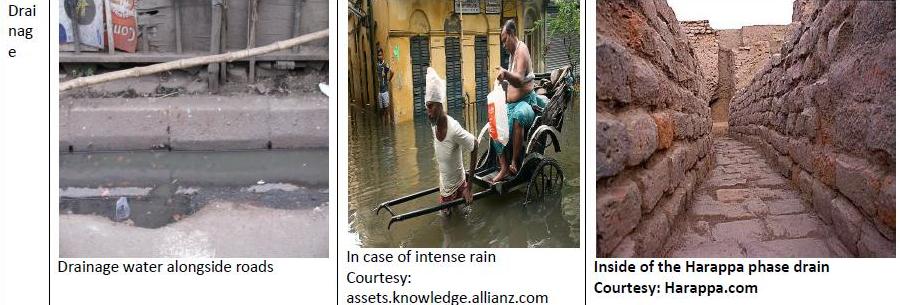
We have dustbins in our house but what percentage of India has it, well I would put that figure to less than 2%. It should not surprise us because 54% of India defecates in the open and 30% of the rural households have latrines, of which 64% have drainage. And these are official figures.[7] We must have sensed the stench coming out of open drains and culverts, probably our ancestors did not like it as much as we do. The streets and buildings of Harappa were provided with drains made of burnt bricks. The houses were equipped with rubbish-bins and attached bathrooms and occasionally with a privy on the ground or upper floor. The bathrooms were connected by drains with sewers under the main streets. The drains were either covered with bricks or stone slabs. It definitely makes us think.

In this age of interior designing and hiring architects for building our houses we still have faults, sometimes we open our window to the polluted smog, the roadside garbage, possibility of people peeping in. but we will be surprised to know that the people followed a very simple practice of no windows facing the street. Those were proper brick houses having rooms.

We talk of standards of trade and goods, several international agreements have been signed. So where did this practice begin? Again we need to refer to the harppan people who began the system of seals and sealing for maintaining quality and standards. The art and craft were beautiful and constructed with basic tools know then like the chisels, knives etc. 

They started with concept of public baths having proper changing rooms which we even lack in all places in today’s era.

Their script hasn’t till date been deciphered. We never know what secrets it might contain.

The cities were built on a raised platform possibly to prevent enemy attack and protect from flood. And we still grapple with daily problems of flooding in one or the other part of India. The Khetri mines of Rajasthan used for extracting copper during those times is still one of the largest contributors of the metal in India. The large number of ports in Gujarat bears testimony to the Lothal dockyard of the IVC. Knowing all this makes a think for a moment that the ET (extra terrestrial) theory might not have been entirely false.

All said and done, coming back to my question- what is the significance of IVC in 21st century? The purpose of historical inquiry is not simply to present facts but to search for an interpretation of the past. Historians attempt to find patterns and establish meaning through the rigorous study of documents and artifacts left by people of other times and other places. Instead of spending so much on promotion of schemes like PMSNY(Pradhan Mantri Sadak Nirman Yojana), TSC(Total Sanitation Campaign), and clean India missions, if we are able to arouse in the people the passion to revive the past of the ancestors of
the human race not bound by religion, caste, creed or faith, but united by commonness of origin.

This can be realized if we could make the people a partner in the projects, not by employing them through MNREGA (Mahatma Gandhi National Rural Employment Guarantee Act), but by making them voluntary partners in the project. If the surplus could be redistributed instead of letting it rot in the open and asking people to come up with gram level or zilla level storage facilities for protection against drought in their own zilla and grams and if need be to neighboring grams at a premium paid by the government. If we could arouse nationalist passions in the people against the rule of the British then it won’t be difficult in arousing their spirits for their own development, for their own upliftment, for gaining inspiration for bringing in a sense of communal harmony and oneness. The great granaries and the wide paved streets of Harappa serve as a role model for the rural and urban areas to aim towards development and the government accelerate the process by merely acting as a facilitator. The long due problems of sanitation could be tackled by making them aware of the glorious past where people had a proper drainage system and used bathrooms. May our glorious past pave the road towards a cleaner, healthier and enriching future.

Below is a pictorial comparison of the current situation when compared with IVC:


References:

[1]. Ancient India-D.N. JHA
[2]. Wikipedia:
[5]. IGNOU BA Course material (courtesy-egyankosh.org)


-----------------------------
Rajan Agarwal has developed a keen interest in comparing ancient and modern India. You can share your views with him at indianpolicy2010@gmail.com

Tuesday, February 5, 2013

Is Africa really that dark ?


We must have often heard the term “Dark” continent being used for the African landmass. But what makes us believe that definition easily ? Well one major factor contributing towards that description is the geography and the social status of the continent. Africa is the world's second-largest and second-most-populous continent. It has 54 countries, 9 territories and three de facto states with limited recognition. Geographically speaking it is a conglomerate of deserts, mountains and dense forests.  Its northern half is primarily desert or arid, while its central and southern areas contain both savanna plains and very dense jungle (rainforest) regions.  Africa is the hottest continent on earth; dry lands and deserts comprise 60% of the entire land surface. It is also home to a variety of "jungle" animals including snakes and primates and aquatic life such as crocodiles and amphibians. Deforestation is affecting Africa at twice the world rate, according to the United Nations Environment Programme (UNEP). According to the University of Pennsylvania African Studies Center, 31% of Africa's pasture lands and 19% of its forests and woodlands are classified as degraded, and Africa is losing over four million hectares of forest every year, which is twice the average deforestation rate compared to the rest of the world. About 65% of Africa's agricultural land suffers from soil degradation. Poverty, illiteracy, malnutrition and inadequate water supply and sanitation, as well as poor health, affect a large proportion of the people who reside in the African continent.

As there are two sides of a coin, the continent also has its riches: The continent is believed to hold 90% of the world’s cobalt, 90% of its platinum, 50% of its gold, 98% of its chromium, 70% of its tantalite, 64% of its manganese and one-third of its uranium. The Democratic Republic of the Congo (DRC) has 70% of the world’s coltan, and most mobile phones in the world are made with elements refined from this mineral. The DRC also has more than 30% of the world’s diamond reserves. Guinea is the world’s largest exporter of bauxite. Slowly the darkness seems to be fading out? A similar effort by Famous geographers like David living stone and Stanley with funding from their native countries discovered several river courses, unearthing the hidden and otherwise ‘dark’ part of the globe.

History:

Gone are those days when Africa was infamous for its slave trade. Slavery had long been practiced in Africa. Between the 7th and 20th centuries, Arab slave trade took 18 million slaves from Africa via trans-Saharan and Indian Ocean routes. . As a result of industrialization, major social problems had grown in Europe: unemployment, poverty, homelessness, social displacement from rural areas, and so on. These social problems developed partly because not all people could be absorbed by the new capitalist industries. One way to resolve this problem was to acquire colonies and export this "surplus population." This led to the establishment of settler-colonies in Algeria, Tunisia, South Africa, Namibia, Angola, Mozambique, and central African areas like Zimbabwe and Zambia.

It was not until the 1930s that slavery in Africa was almost totally eliminated. Which paved the way for the second scramble for Africa via trade relations and diplomatic channels. Two countries in Asia became the forerunners of this scramble, India and China - in similar yet different ways.

Enter the Chinese Dragon:

China’s entry into Africa is characterized by ‘an aid-for-oil strategy’. The traditional model of Sino-African trade is one in which Africa exported energy and raw materials (minerals, precious stones, timber, cotton, fish products) and imported consumer goods, machine tools and textiles. Oil ranks first among Chinese imports, accounting for 60 per cent of total imports. Imports from Africa now represent 25 per cent of all China’s oil imports, and this percentage is on the increase. Sixty per cent of Sudan’s oil yield and 25 per cent of that of Angola are exported to China. China also has an interest in the raw materials and minerals needed to sustain its growth, including copper, nickel, iron, bauxite and uranium. In 2004, 20 per cent of Africa’s mineral ores were exported to China. The cost regimes adhered to by Chinese companies, and the fact that Beijing prefers ‘empty’ areas, in which the safety of neither investment, nor personnel is guaranteed, facilitates the Chinese offensive considerably. China takes the kinds of risk that would be inconceivable for any major Western company. China also benefits from not imposing conditions and not requiring that the rules of transparency and good governance be observed, in contrast with Western investment programmes.

Indian roar not lost:

India imports 70% of its oil, much of it from the politically volatile Middle East. Finding new suppliers to diversify its oil sources is crucial to its energy security and Africa is an attractive option. Africa accounts for 11.4 percent of global oil production, holding 9.4 percent of the world's reserves. India's diamond-cutting industry – the world's largest – depends on rough diamonds from Africa, while uranium in Niger, Uganda and Tanzania is vital for India's nuclear power industry. There are other reasons too for India’s renewed interest in Africa. Africa is rich in votes at the UN General Assembly, which India needs when it pushes for a seat in the Security Council.  Realization of its strategic ambitions too hinge on cooperation with Africa. India is keen to assert its naval power across the Indian Ocean from Africa’s east coast to the western shores of Australia. This has prompted it to step up naval cooperation with Africa’s Indian Ocean littorals like Seychelles, Mauritius and Madagascar. Tackling problems like piracy off Somalia’s coast too requires India to work with Africa. Trade with Africa jumped from U.S. $3 billion in 2000 to $52.81 billion in 2010-11 and is expected to exceed $90 billion by 2015.

India’s interest in Africa is thus multifaceted the focus being energy importing hub. The trends in trade, the diverse investment profile, as well as various initiatives to augment technical assistance, training and capacity building in Africa, suggest a strategy that has married components of the earlier idealistic policy with strands of pragmatism.

Historically, India was active in Africa’s Anglophone countries and in East Africa. It was the large Indian diaspora in countries like Kenya, Tanzania and Mauritius that facilitated close economic relations

A comparative study of aims of African policy:


But these idealistic aims camouflage within themselves selfish and self-centered motives like creating a land pool, using African labour on leased lands, potential dumping ground, international political benefits extraction of large amounts of energy resources etc.

India is expanding its footprint in Africa so aggressively that a mighty buzz has arisen about Sino-Indian rivalry for influence on the continent. On the face of it, India and China are not in the same league when it comes to trade with Africa. While India’s two-way trade with Africa soared from about $1 billion in 2001 to $46 billion in 2010, it is eclipsed by China’s, which surpassed $120 billion in 2010. China’s economic hard power capabilities have successfully blocked Indian investment in Africa’s primary sector, especially in critical countries such as Angola, Algeria, Zambia, Sudan etc. India’s bilateral trade and investment with Africa also pale in comparison to those of China. And the nature of the Chinese economy far greater than India’s makes competing in Africa an extremely difficult task and presence of high-profile Chinese ventures on the continent further challenges India’s cultivation of strategic ties with Africa: a situation which could eventually impact on India’s energy security, given its dependency on African resources.

Conclusion:

Coming back to the darkness of the continent, Africa has come a long way from the slave era to the “waka-waka” era as I would like to call it. Considering the history of Africa and then believing that the FIFA 2010 happened in South Africa which celebrated its first democratic non-racial election as late as 1994. So the diamond mines of Africa have succeeded in outshining the dark curtain which covered it for several centuries. Although Africa has benefitted a lot from global trade but it still has a long way to go considering the wide-spread poverty and illiteracy in Africa.

References: 
--------------------------------------
   Rajan Agarwal likes following the activities of India and China in Africa. You can write to him at indianpolicy2010@gmail.com

UNCCD and India


“Desertification is a phenomenon occurring in the great Sahara desert”. Well if you are of this view point then you surely need to brush up your ecological senses. Desertification is not new. The Sumerian and Babylonian empires are among several ancient civilizations thought to have declined more rapidly after their agricultural output fell because of prolonged desiccation and water scarcity. Deserts expand naturally, but "desertification" is a different process where land in arid, semi-dry areas becomes degraded, soil loses its productivity and vegetation thins because of human activities and/or prolonged droughts/floods. Desertification occurs when:
  • the tree and plant cover that binds the soil is removed. It occurs when trees and bushes are stripped away for fuel wood and timber, or to clear land for cultivation.
  • animals eat away grasses and erode topsoil with their hooves.
  • intensive farming depletes the nutrients in the soil.
Wind and water erosion aggravate the damage, carrying away topsoil and leaving behind a highly infertile mix of dust and sand. It is the combination of these factors that transforms degraded land into desert. Globally, the rate of desertification is speeding up, the UN Environment Program (UNEP) says. Africa is the worst affected continent; with two-thirds of its land either desert or dry lands. Almost a third of land in the U.S. is affected by desertification; and one quarter of Latin America and the Caribbean, and one fifth of Spain. The Sahara is currently expanding south at a rate of up to 48 kilometers per year.

UNCCD:

In 1994, the UN Convention to Combat Desertification (UNCCD) was adopted “to combat desertification and mitigate the effects of drought in countries experiencing serious drought and/or desertification, in particular in Africa”, is the sole legally binding international agreement linking environment and development issues to the land agenda.. The world has recognized the degradation of dry lands by proclaiming 2006 the International Year of Deserts and Desertification and by observing World Day to Combat Desertification on 17 June. The Convention addresses specifically the arid, semi-arid and dry sub-humid areas, known as the drylands, where some of the most vulnerable ecosystems and peoples can be found. In the 10-Year Strategy of the UNCCD (2008-2018) that was adopted in 2007, Parties to the Convention further specified their goals: "to forge a global partnership to reverse and prevent desertification/land degradation and to mitigate the effects of drought in affected areas in order to support poverty reduction and environmental sustainability". 

The UNCCD urges affected country Parties to align their action programmes, as well as other relevant implementation activities relating to the Convention, to the UNCCD's 10-Year Strategy. India became a signatory to the UNCCD on 14th October 1994 and it came into effect on 17th March 1997. One of the obligations of all developing country Parties to the Convention, including India, is to prepare the National Action Programme to Combat Desertification and to mitigate the effects of drought.

India's role:

As a signatory to the UNCCD, India has been meeting its obligations through implementation of various programmes and reporting the progress to the UNCCD every 4 years. The fourth National Report has been submitted to the UNCCD secretariat. 

Besides the above programme several schemes have been implemented jointly by India and UNCCD:

Land for Life Award:

The Land for Life Award was launched at the tenth session of the Conference of the Parties to the United Nations Convention to Combat Desertification (UNCCD) seeking to promote efforts for sustainable land management. The Land for Life Award will provide global recognition to individuals, teams, institutions, businesses, research institutes, public offices, political leaders, decision-makers, journalists, media, nongovernmental organizations and civil society organizations whose work and initiatives have made a significant and innovative contribution to sustainable land management.

The Award will reward initiatives which contribute directly or indirectly to the regeneration and/or enhancement of soils' natural health and productive capacity or to the sustainable regeneration of depleted or drought affected lands. The inaugural prizes were won by organizations from Haiti, Uganda and Turkey.

The Sustainable Land and Ecosystem Management (SLEM) Programme:

The Sustainable land and Ecosystem Management (SLEM) Programme is a joint initiative of the Government of India and the Global Environmental Facility (GEF) under the latter’s Country partnership Programme (CPP).The objective of the SLEM Programmatic Approach is to promote sustainable land management and use of biodiversity as well as maintain the capacity of ecosystems to deliver goods and services while taking into account climate change.

MOEF:

The Ministry of Environment and Forests, as the National Focal Point for the implementation of the Convention, initiated the process of preparation of National Action Programme through the setting up of a High-Level Inter-Sectoral National Steering Committee (NSC) in July 1999. The NSC decided to constitute four Working Groups (WG) on various issues relevant to desertification. These are:
  • WG#1- Desertification Monitoring and Assessment,
  • WG#2- Sustainable Land Use Practices for Combating Desertification,
  • WG#3 - Local Area Development Programme, and
  • WG#4 - Policy and Institutional Issues
Policies and acts:

Though India does not have a specific policy or legislative framework for combating desertification as such, the concern for arresting and reversing land degradation and desertification gets reflected in many of our national policies (for e.g., National Water Policy 1987; National Forest Policy 1988; National Agricultural Policy 2000; National Environmental Policy 2006; National Policy for Farmers 2007; National Rainfed Area Authority (NRAA)- 2007) which have enabling provisions for addressing these problems.

To this effect several laws have been legislated, a few of them are:
  • Forest (Conservation) Act, 1980
  • Environment (Protection) Act, 1986
  • Biodiversity Act, 2002
Fourth five year plan (1969-1974) - Environment as an issue was realized and resulted in the setting of the National Committee on Environmental Planning and Coordination (NCPEC). 

Sixth five year plan (1980-85)- Constitution of the Department of Environment. Land degradation issues also received attention with the setting up of the National Wastelands Development Board (NWDB).

The programmes for combating desertification under the NATIONAL ACTION PROGRAMME can be broadly classified under the following major areas: 
  • Social sector programmes based on community and human development and particularly at the local level.
  • Programmes specifically for poverty eradication
  • Programmes for conservation of natural resources.
  • Programmes for eco-restoration of degraded lands.
  • Programmes specially for desert and drought prone regions
  • Measures to combat and mitigate the effects of drought.
The problem remains:

Although a number of schemes have been initiated yet the prime task still remains of creating awareness among the masses. People are still rampantly cutting down forests; barely 20% of the original existing virgin forests of earth remain. Of late some positive activities like afforestation, laws preventing logging, poaching etc have been legislated but the sad part is the lack of strict implementation of the law. What you need is a sense of urgency and a strong will to act. Taking a vow, not to cut trees or allow others to do the same by bringing it to the notice of the concerned authorities. Anything which is forced upon the citizens is difficult to implement but the moment citizens begin to take interest in the activity and consider environment as a part of their life and their moral responsibility to protect the same, the several million hectares of barren land affected by desertification can be brought to life again. UNCCD and MOEF should merely serve as a facilitator and promoter not as a regulator and enforcer, only then could we experience a positive change. Our responsibility must not end at earning a living for us and our families but also making the environment greener to earn its own. In this light we have the concept of CSR i.e. Corporate Social Responsibility and Sustainable development. 

Desertification is nearly as critical as climate change - this is something we must understand. Traditional practices of water storage and conservation and mixed farming that integrates perennial trees and grasses with crop cultivation and livestock rearing, which proved as best practices for sustainability and resource conservation, are now disappearing. As a consequence, about 92% area in arid Rajasthan is now affected by desertification. About three hundred years ago, several hundred members of the Bishnoi community in Rajasthan, led by a woman, Amrita Devi, attempted to save their sacred Khejri trees by clinging to them. They were not psychopaths but people who could foresee that the race for survival in the future culminating in the forests and not in barren deserted lands. Those sacred groves, kunds, tanks and other traditional methods of water and forest conservation need to be brought back because the earth and its citizens need more than just the small tulsi or money plant in your house. As a first step start with E-bill, it will go a long way in reducing logging.


References:

Wikipedia
Civils India, environment and ecology
The Hindu

----------------------------------
Rajan Agarwal is concerned with the devastating effects of desertification. You can share your views with him at indianpolicy2010@gmail.com

Saturday, January 26, 2013

Drinking Water & Sanitation in rural India


Poor sanitation and lack of toilets cost India nearly three trillion rupees because of hygiene-related illness resulting in poor productivity. The problem is not only economic but also of human dignity. The practice of manual scavenging is the worst violation of the individual’s right to life with dignity. Providing safe drinking water is another major challenge for the government. Having 4% of world water and supporting 15% of world population is an arithmetic the magnanimity of which even a lay man can understand.

It is estimated that 1 in every 10 deaths in India in villages, is linked to poor sanitation and hygiene. The Improved sanitation facilities in rural India stood at 23% in 2010, according to a World Bank report published in 2012 as compared to 58% in the urban areas. Overall in India roughly 72% lack basic sanitation facilities. The question arises what comprises the definition of ‘basic sanitation’.  Basic sanitation is described as having access to facilities for the safe disposal of human waste (feces and urine), as well as having the ability to maintain hygienic conditions, through services such as garbage collection, industrial/hazardous waste management, and waste water treatment and disposal. Residing in urban localities we might wonder what the big deal in these services is, but let me put before you some raw fact regarding the services we have taken for granted-“54% of India defecates in the open, 50% wash their hand with soap after contact with excreta, 30% rural households have latrine facilities, of these 64% have no drainage”.

Sewerage was introduced in India a few years after the advent of British, in 1870 in Kolkata. Yet the current scenario is such that in India out of over 4800 town/cities only 232 have the sewerage system and that too partially. A major flagship program of the government has been the “Total Sanitation Campaign” which has the Nirmal Gram Puraskar Scheme to encourage Panchayti Raj Institutions. Sikkim has become the first state to receive this award, with Kerala following.

Of the various studies conducted by UNICEF, WHO and other national and international bodies one major point which has emerged and agreed upon by all is the unparalleled role of women in promoting sanitation. Almost one out of two persons lives without toilet. Children from female-headed families were found much more conscious and concerned about personal hygiene. The problems suffered by the female fold were manifold making them silent sufferers of a very much solvable problem .Rural women suffer more from men from the indignity of being forced to defecate in the open, at risk of assault and rape. Due of the lack of toilets in schools in rural areas, boys and girls feel ashamed and experience difficulties, which often leads of higher drop-out rates particularly of girl students. 

Manual scavenging, a term that is the nadir of human dignity, yet the very practice is far from termination sadly in our very own India. The coming of the law of 1993(The Employment of Manual Scavengers and Construction of Dry Latrines [Prohibition] Act) as late as it may sound is an unenforced one. The biggest blot being the disputed numbers, of state governments claiming 116 thousand while reports putting the numbers at 1.3 million. The 1993 law defined a manual scavenger as “a person engaged in or employed for manually carrying human excreta”. The 2012 bill definition is fittingly more elaborate and inclusive, and includes “a person engaged or employed... for manually cleaning, carrying, disposing of, or otherwise handling in any manner, human excreta in an unsanitary latrine or in an open drain or pit into which the human excreta from the insanitary latrine is disposed of, or on a railway track...”

But the advantages of the expanded definition are completely undone by the proviso that a person who cleans “excreta with the help of such devices and using such protective gear, as the Central Government may notify in this behalf, shall not be deemed to be a “manual scavenger”’. No such proviso was there even in the 1993 law. It deliberately introduces a huge escape route: employers may merely issue gloves and protective clothing, which the Central Government notifies as sufficient, and this would be sufficient to allow the demeaning practice to persist.

The document about manual scavenging will remain incomplete without the mention of the BADAUN model. Badaun is a district in Uttar Pradesh where a multi-pronged approach was used - eradication, rehabilitation and SWOT (strength, weakness, opportunity, threat) analysis. The various sections of the society merged together to completely eradicate this practice.

Kerala’s E-toilets are a major boost towards the efforts of providing sanitation facility to all. Well you heard it right E-toilet! it works on total auto-mode: The insertion of  coin opens the door for the user, switches on the light and even directs the user with audio commands, programmed to flush 1.5 liters water for under 3 minute usage and 4.5 liters thereafter. They can be programmed to clean the platform after every 5 or 10 persons use the toilet. These could be tracked via GPS and other mapping facilities.

Water scenario is continuously worsening thanks to the rapidly increasing population, rising demand for irrigation, rapid urbanization, electricity generation, global warming and erratic rainfall. Besides absence of a concrete water policy and dolling out huge subsidies to the agricultural and industrial sector has cost India dearly.65000 villages are still “no source” villages and estimated 200 million people access unhygienic water.185 districts in India have polluted water containing nitrates, fluorides, chlorides, arsenic, zinc, iron and salinity. In view of the increasing problem of water quality and resultant health hazards, it is necessary to institutionalize water quality monitoring and surveillance systems. India’s per capita storage capacity is currently at 190 cubic meters which is very less compared to china’s 2486 and Brazil’s 3388. A significant increase in incomplete irrigation projects have escalated their costs by up to 1000% (thousand) and more. The government has finally awaken to the uncalled for situation and come up with Draft Water Policy, 2012 which inter alia emphasizes on government’s role as a service provider rather than creator, doing away with subsidies.

According to Shree Rajendra Singh of Tarun Bharat Sangh,” Water is an endowment of nature to mankind and is not a property of the state or any individual and is never a private asset”, something which all should remember. He insists on compensation for dislocated people at par with those benefited with a certain percentage coming by imposition of taxes on the benefited class.

All said and done, you might be prompted to lay 90% blame on the government of India, but we must keep the following points in mind. During the initial years improvement in agriculture was a major requirement as such it comprised of 22% of the budgetary grants. Next the drinking water and sanitation also received Rs two hundred billion under the TSC (total sanitation campaign). But the problem lies in implementation of these monetary grants for maximum utilization by the public. Integration and coordination at all levels of governance and administration is the need of the hour. You might construct for them a toilet and they might agree to use it but getting rid of age old habits is not easy, it is here that the enforcement becomes difficult. India might a emerging economy engaging in nuclear tests, modern warfare- air-crafts, missiles, tanks but it cannot become a developed nation until it provides its citizen a life with dignity under article 21 which it is supposed to guarantee and basic housing facility under the universal declaration of human rights. The task might be a herculean one but efforts in all levels of implementation could go a long way forward in increasing the economy and productivity, decreasing mortality rate and health costs. These facilities are the bare minimum a citizen expects from the ruler of the land. If we, as engineers device innovative solutions, we as doctors preach compulsory sanitation, we as lawyers file PILs, we as citizens use the instrument of RTI, we can expect a change.

The TSC is currently being implemented at scale in 606 districts of 30 states/Union Territories (UTs). As can be seen from Figure 1, after sluggish progress throughout the 1980s and 1990s, rural Sanitation coverage (individual household latrines) has nearly tripled from approximately 22 percent in 2001 to 61 percent in 2009 and 65 percent in 2010, post-TSC and -NGP.

Courtesy: Government of India, Department of Drinking Water Supply http://ddws.nic.in. Accessed in March 2010
References:  

1. Kurukshetra magazine
2. www.pib.nic.in,
3. The Hindu,
4. UNICEF reports,
5. TSC report_volume 1,
6. www.mdws.gov.in

-------------------------------------
Rajan Agarwal wants to raise awareness about the problems related to water, that India is facing currently. You can write back to him with your comments  at indianpolicy2010@gmail.com

Sunday, January 20, 2013

IRDA & PFRDA


IRDA

In India, insurance has a deep-rooted history. It finds mention in the writings of Manu ( Manusmrithi ), Yagnavalkya (Dharmasastra ) and Kautilya ( Arthasastra ).1818 saw the advent of life insurance business in India with the establishment of the Oriental Life Insurance Company in Calcutta. This Company however failed in 1834. Thereafter several companies came and post independence after nationalization we had LIC by the ordinance of 1956. Following the recommendations of the Malhotra Committee report, in 1999, the Insurance Regulatory and Development Authority (IRDA) was constituted as an autonomous body to regulate and develop the insurance industry. The IRDA was incorporated as a statutory body in April, 2000.

Today there are 24 general insurance companies including the ECGC and Agriculture Insurance Corporation of India and 23 life insurance companies operating in the country.

Composition:

The Authority is a ten member team consisting of

(a) a Chairman;- HARI NARAYAN
(b) five whole-time members;
(c) four part-time members,

(all appointed by the Government of India)

Duties: 

Section 14 OF THE IRDA Act,1999 lays the duties. Some of them are as follows -
  1. To protect the interest of and secure fair treatment to policyholders;
  2. To bring about speedy and orderly growth of the insurance industry (including annuity and superannuation payments), for the benefit of the common man, and to provide long term funds for accelerating growth of the economy;
  3. To set, promote, monitor and enforce high standards of integrity, financial soundness, fair dealing and competence of those it regulates;
  4. To ensure speedy settlement of genuine claims, to prevent insurance frauds and other malpractices and put in place effective grievance redressal machinery;
  5. To promote fairness, transparency and orderly conduct in financial markets dealing with insurance and build a reliable management information system to enforce high standards of financial soundness amongst market players;
  6. To take action where such standards are inadequate or ineffectively enforced;
  7. To bring about optimum amount of self-regulation in day-to-day working of the industry consistent with the requirements of prudential regulation.

PFRDA

PFRDA was established by Government of India on 23rd August, 2003. The Government has, through an executive order dated 10th October 2003, mandated PFRDA to act as a regulator for the pension sector. The mandate of PFRDA is development and regulation of pension sector in India.

The Authority shall consist of a Chairperson and not more than five members, of whom at least three shall be whole time members, to be appointed by the Central Government. The present chairperson is Shri Yogesh Agarwal.

The New Pension System reflects Government’s effort to find sustainable solutions to the problem of providing adequate retirement income.

The Union Cabinet approved the introduction of certain official amendments to the Pension Fund Regulatory and Development Authority Bill, 2011. Based on the recommendations of the Standing Committee on Finance, the Government has decided to accept the following:
  1. That the subscriber seeking minimum assured returns shall be allowed to opt for investing his funds in such schemes providing minimum assured returns as may be notified by the Authority;
  2. Withdrawals not exceeding 25 per cent of the contribution made by subscriber will be permitted from the individual pension account subject to the conditions, such as, purpose, frequency and limits, as may be specified by regulations by the PFRDA
  3. The foreign investment ceiling in the pension sector at 26 per cent or such percentage as may be approved for the Insurance Sector, whichever is higher may be incorporated in the present legislation;
  4. To establish a vibrant Pension Advisory Committee with representation from all major stakeholders to advise PFRDA on important matters of framing of regulations under the PFRDA Act.
  5. The membership of the PFRDA will be confined to professionals having expertise in economics, finance or law only.

The New Pension Scheme (NPS) has been made mandatory for all the Central Government employees (except Armed Forces) entering service with effect from 1.1.2004. 27 State / UT Governments have notified NPS for their employees. NPS has been launched for all citizens of the country including unorganised sector workers, on voluntary basis, with effect from 1st May, 2009. Further, to encourage people from the unorganised sector to voluntarily save for their retirement, Government has launched the co-contributory pension scheme titled "Swavalamban Scheme" in the Budget of 2010-11. As on 7th September, 2012 the number of subscribers under NPS is 37.45 lakh with a corpus of Rs. 20535.00 crore.

PFRDA also intends to intensify its effort towards financial education and awareness as a part of its strategy to protect the interest of the subscribers. PFRDA’s efforts are an important milestone in the development of a sustainable and efficient voluntary defined contribution based pension system in India.

------------------------------
Rajan Agarwal is a student of Engineering and currently doing some research of the evolution of insurance in India along with pensions. You may contact him at indianpolicy2010@gmail.com

Saturday, January 12, 2013

Ethnic Conflict


Ethnic conflict is a major issue worldwide; the Tamils and Sinhalese in Sri Lanka, ethnic clash in Sudan, ethnic clash between Israel and Palestine, the list is in-exhaustive.

In the aftermath of independence, Indian leaders such as B R Ambedkar and Jawaharlal Nehru were wary of the dangers of federalism resulting in ethnic succession and balkanization of the state. However, the political elites had to accept ethnic plurality and agreed that in the face of national integration and development, creation of a secular and federal polity was unavoidable.

A spate for demand for statehood started from the 1960s and ever since, even the demand of frivolous groups has been gaining momentum. Faced with such uprisings some pertinent questions arise such as—
  • Why has there been a growth in separatist sentiments among minority ethnic groups in different parts of India?
  • Would separate statehood actually work to make life better for the people of the state?
Thirty years hence independence, INC was the central political organisation of India. However, under the authoritarian leadership of Indira Gandhi, the secular and democratic spirit of the country came under a constant threat. Her desperate measures to retain power at the centre oversaw political criminalization of Indian polity, politicization of Indian bureaucracy and security agencies, and arrogance with the opponents of the congress party. For the first time India witnessed defeat of the congress at the centre and the formation of a coalition government. Soon, regional parties started mushrooming across the country. Such political pieces gained power by tapping into ethno-linguistic, religious and regional sentiments.

Researchers have categorized four broad categories as the cause of ethnic political mobilization and agitation—

First, the ethnic group fear cultural dilution.

Second, modernization has induced large-scale population migration, forcing ethnic groups to live in close proximity and compete with other groups for rewards and resources. This has increased their socio-political awareness and their capacity to politically mobilize for collective action.

Third, unequal development of ethnic groups, poverty, exploitation and lack of opportunity has triggered strong feelings of relative deprivation among ethnic groups and spark ethno-political movements.

Finally, political factors such as mal-governance rise of regional political parties and formation of weak coalition governments at the centre may also contribute significantly to such outbreak.

The truth is, political powers are riding piggy-bank on such sentiments and fuelling indigenous group-protest for personal benefits. The Indian political platform has seen the rise of selfish interest and motives over the common good. A handful are profiting from such agitations and shoving the welfare of the country under the carpet. Power-hungry interest groups are thriving while the populace goes back to the old drudgery of life. Statehood is only a momentary pacification of the angry, impulsive mass. In the long term, the leaders must be true to their commitment to the people to bring about any real change in their livelihood.

As late as 1830, a British Governor in India, Sir Charles Metcalfe, described the village community as follows—

“The village communities are little republics having nearly everything they want within themselves and almost independent of foreign relations. They seem to last where nothing else lasts. This union of the village communities, each one forming a seperate little state in itself…is in a high degree conducive to their happiness, and to the enjoyment of a great portion of freedom and independence.”

The picture of village swaraj as conceived by Gandhiji is not the resurrection of the old village panchayats but the fresh formation of independent village units of swaraj in the context of the present-day world. According to Gandhiji, ideal society is a stateless democracy, the state of enlightened anarchy. Such an ideal is as elusive as the Euclid’s line which can never be possible in reality, but, “it is only by keeping the ideal line in mind that we have made progress in geometry”.

India has over two thousand ethnic groups. If the demands of statehood from ethnic groups are met with, such demands will increase in number and capacity. Soon, we will run out of numbers to count our states. However, organizing them into independent hamlets seems a progressive way of adopting Gandhiji’s farsighted ideas. Gandhiji was a true visionary. Thus, instead of fragmenting India into atomic pieces and chalking out meaningless boundaries we must work from bottom upwards. Gandhiji ultimately stressed on the power of the individual who is the crucial unit in the vision of a village swaraj.

Modern democracies are election-centred, party-dominated, power-centric complex mechanism. And in such a scenario the individual has been relegated to the position of a dumb, mechanic, programmed voter. Individuals are make-belief masters and upholders of democracy. The truth is, they present themselves at periodical elections for casting their vote and then sleep away until the next one. Such actions are once again, under the careful monitoring of a centralized party system and the guidance of the newspapers which are mainly tools of prominent political powers.

The only pathway of transforming these menial dumb-waiters into thoughtful, intelligent human beings is via education. Education is not the art of caricaturing one’s signature. Education is imparting of knowledge. Knowledge is power. Nelson Mandela says,” Education is the most powerful weapon which we can use to change the world”. Thus, in order to realise Gandhiji’s dream, we need to educate the masses to mould him into that crucial unit.

------------------------------------
Payel Halder has chosen Indian Policy to share her views on Indian democracy and its associated issues. You can contact her at indianpolicy2010@gmail.com