Friday, October 21, 2011

Nepal-India relations


A vision for Nepal-India relations - Baburam Bhattarai

My visit to India, which begins today, has great historical significance.

Nepal is passing through a major political transition. We fought against feudal autocracy and monarchy, and for overall socio-economic transformation, for almost 60 years. At times, our movement was peaceful, and at times, violent. But the consistent goal was to abolish feudal autocracy and monarchy, and democratise the state and society. Ultimately, the major political parties — which included the Maoists and traditional parliamentary parties — reached an agreement in 2006 to overthrow the monarchy and institutionalise democracy through the Constituent Assembly (CA).

Peace, constitution and India

We succeeded in abolishing the monarchy, and ushering in a new democratic era in Nepal. We are now in the process of institutionalising achievements through the CA, accompanied by socio-economic transformation, and federal restructuring of the state. According to the Comprehensive Peace Agreement (CPA), signed in November 2006, we are now trying to complete the specific task of army integration and other aspects of the peace process. We are also trying to complete the process of writing the Constitution through the CA. Only after wrapping up this entire process will these gains be institutionalised, and we will enter into a new era of democracy, change and development in Nepal.

The role of India in this process is crucial. Nepal and India share a very unique relationship. Nepal is sandwiched between two huge states of India and China. But we are virtually India-locked, as we have an open border on three sides. Most of our socio-economic interactions take place with India. Two-thirds of our annual trade is with India, while only 10 per cent is with China. Given this historic tilt towards India, our bilateral relationship is unique. When you have more interaction, you have more problems and more friction. At times, there are misgivings and misunderstandings on various issues — some are genuine, while others are born out of scepticism.

India played a positive role in the peace process in Nepal, and during our transition towards democracy. My visit, at this juncture when we are at the last stage of completing the peace process, assumes special significance. While the peace process is basically conceptualised and led by Nepali political forces, the goodwill of international forces, particularly our neighbours, is very important for its success.

Security and development

An important bilateral issue between Nepal and India is related to politics and security. Nepal virtually lies in the southern lap of the Himalayas, and shares borders with two huge states of Asia. This geopolitical reality has to be taken into account. Naturally, there would be political and security concerns of our neighbours which Nepal is committed to observe keeping in mind mutual interests. Nepal will not allow its soil to be used against the security interests of any of its neighbours. Another key issue is economic development and development of resources. In the present day world, the economy of every country is interlinked with that of others, especially neighbours. If we have to prosper, we can only prosper if we cooperate with each other. Poverty and underdevelopment in the neighbourhood will have a fallout, and hamper your own development.

India and China are developing at a fast pace. Nepal, lying between two fast-growing economies, cannot remain backward and under-developed. We will seek the cooperation of both our neighbours, especially India.

We have to find areas of economic co-operation for mutual benefit of India and Nepal. One major field is the exploitation of water resources for mutual benefit. The next is drawing in Indian investment to Nepal — we are committed to creating a conducive environment for investors and providing them security. The trade balance between our two countries has been quite skewed. Our trade deficit with India is quite huge. The import-export ratio is about 7:1, which is not sustainable. That is another area where we have to deepen our economic cooperation.

Personally, I have had the opportunity to get my education in India, and my area of interest has been economic development. I will try to utilise my relations developed over the years to enhance bilateral relations, especially designed towards maximising economic benefits for both sides.

If Nepal can develop faster, it can become a development partner for India. For India also, a more developed Nepal will be a better guarantee of its security as only with development, peace, and stability, there can be security. Security concerns cannot be treated in isolation, but must be viewed in totality. Security and economic development must be seen together.

Trust and goodwill

The visit to India is basically directed towards building a better understanding between the two countries and two peoples. In that sense, it is a goodwill visit.

My personal thrust would be to have a very free and frank discussion with my counterparts so that we can upgrade the relationship according to contemporary needs. The relations and agreements institutionalised in the 20th century may not be enough to meet the needs of the 21st century. Hence, the emphasis would be to develop our relations further, clear misgivings and misunderstandings that we have against each other, and sort out the problems left by history. When the subcontinent was colonised by the British, they left behind a legacy which has created friction among the nations of South Asia. We have to overcome that, and develop mutual relations in the changed time and context. Instead of harping on old disputes, Nepal would like to look forward, and create an atmosphere of cooperation.

There are certain political issues, which would need more discussions. We can engage on it freely and frankly, but they can be postponed for the future. The major thing is to build trust between our two countries, two governments, and two peoples. Once there is trust, and we are sensitive and empathise with each other, even the most difficult issues can be resolved amicably.

A new era

To reiterate, instead of pushing any specific agenda, I want to talk about all the issues in a friendly spirit, with the aim of conveying and understanding bilateral concerns. This will also be an opportunity to interact with those outside government, especially civil society, media, and intelligentsia. Given my long association with Delhi, I have several personal acquaintances there and look forward to renewing those relationships.

It is my strong conviction that my current visit to New Delhi will usher in a new era in our bilateral relations. Nepal is in the last phase of completing its peace process, and is about to enter a new phase of peace and development. Our new bilateral relationship, which will be based on a strong development dimension, can bring about peace and prosperity.

My dream is to have an inclusive democracy, sustainable peace and prosperity in this part of the world. Nepal will try to contribute its best to foster that relation among all the countries of South Asia. Nepal-India relations can be developed as a model of cooperation between neighbours. I am quite confident that after this visit, traditional misgivings between the different actors in Nepal and India will substantially be cleared, and a foundation for better partnership for development in the 21st century would be laid.

( H.E Dr. Baburam Bhattarai is the Prime Minister of Nepal. He arrives in New Delhi today, on his first bilateral visit after taking office .)

The major thing is to build trust between our two countries, two governments, and two peoples.

Friday, October 14, 2011

How to restore the government's credibility ?


(Vinod Rai is the Comptroller and Auditor General of India. This article is an edited excerpt, prepared by The Hindu , of the speech he delivered to young police officers at the Sardar Vallabhbhai Patel National Police Academy in Hyderabad on October 11, 2011.)

I wish to make three propositions today and seek your reactions on whether you agree and whether you are in a position to be a participant in ensuring that the All India Services regain their past glory.

First: That governance is at its lowest ebb. That the morale of the civil servants is low. That credibility of the government is at its lowest. That decision-making has become a casualty. Second: That this situation is deleterious for the nation. That too much is at stake for too many in such a situation. Third: On you and officers of the All India Services, among others, rests the onus to remedy the situation.

Why do I make my first proposition? We have Chief Ministers who have had to vacate their positions allegedly for graft, on whom courts and other judicial bodies have made adverse pronouncements. We have Union Cabinet Ministers who are in prison. We have Union Cabinet Ministers who have had to vacate their positions, allegedly on complaints of ill doing. We have Members of Parliament who are being indicted by the judiciary for various acts, including accepting cash for exercising their vote in Parliament and also seeking cash to ask questions in the House. In the civil service we have many examples. They are too many to merit counting now!

Today, we are facing a testing time in the history of our nation. The quality of governance is below par. There has been an erosion of people's faith in government. Their confidence in public institutions has declined. National trust in the bureaucracy, including the police force has collapsed. The integrity and professionalism of civil servants are being questioned. This has brought the credibility of the government to the lowest since Independence.

Can you and I stand up in the society and claim we belong to a service which administers this country with probity and efficiency? Most of us would not be able to convince ourselves that we are capable of being part of a legacy which provided this nation the foundations on which the edifice of good governance stood. And that is where the greatest challenge to the police force lies today, when the moral fabric of the nation seems to be tearing apart in the absence of an optimal governance system, characterised by a near total absence of accountability; where loyalty takes precedence over the sense of one's duty, and where national interests are often, and with impunity, subjugated to individual gains.

Today in some quarters there is sharp criticism of the police force for being perceived as principal violators of the law, exhibiting rude behaviour, abusive language, lack of professionalism and insensitivity towards victims of violent crimes. This perception has to be reversed. Public confidence in the police has to be restored. As leaders, you must change the mindset of the police force if you want to be seen as friendly, compassionate and sensitive to the genuine concerns of the people. This can happen only if we can substitute the ‘force' psychology that permeates significant sections of the police organisation with a ‘service' psychology.

Including the citizen

Now I come to my second proposition: Why do I say that too much is at stake for too many people? As all of you are aware, we are among the fastest growing economies of the world. This is indeed commendable. But, there is no room for complacency. We have to ensure smooth development and ‘inclusive growth'. Our actions will provide stability in the nation, thereby ensuring rapid economic growth. It is a poor commentary on our attempts to foster growth if 64 years after Independence we still believe Rs.32 defines a poverty line!

We are living in an era in which good governance has assumed primacy in public discourse as it is expected to lead to improvement in the quality of life of citizens. Ironically, the demand for good governance is entwined with the demand for less governance as well. However, it is universally agreed by all those propagating a minimal state approach that ensuring the security of the citizens is a primary duty of the state which cannot be diluted in any manner. The responsibility assigned to the members of the Indian Police Service is to make this a reality.

All of us in government must recognise that the citizen in our democracy has come centre-stage. He has become very discerning, demanding. Governance by use of force is no longer of any consequence.

No instrument or institution of the State can remain immune to the evolutionary process taking place in our society. The public demand for shift of power from bureaucrats to citizens has led to change of governance structures. In fact, there are even demands for sharing of the legislative functions by moving from a representative raj to direct people's raj . All these demands stem from an increased awareness of the citizen to participate in decisions relating to governance, development and welfare entitlements through decentralised governance structures.

In the audit arena, this is recognised through social audits, in which citizens are actively involved in planning and executing the audit and by disseminating the reports to the affected community. In the police force, this finds expression through the concept of community policing. I do not see this merely as a strategy to overcome the human resource shortage in our police forces or as a cost cutting measure. Rather, it is an act of faith in the capabilities of our fellow citizens to govern themselves. Each terrorist attack in our country is yet another grim reminder to us that extremist acts can be tamed only through active involvement of the public in management of security. You cannot find a better force multiplier than the one billion Indians ever willing to render a helping hand. However, this can succeed only if police officers are willing to shed traditional notions of policing and begin to consider the citizen as partners in law enforcement.

Not adversaries

My third proposition: The earlier we accept the need to promote change and innovation, the earlier we would have established the efficacy of the police service and, thereby, the credibility of government. This would restore public confidence in the state. And that is why I stand before you to request that you become the change agent.

All attempts to improve governance will come to naught if the agencies responsible for governance do not consider probity in public life and ethical behaviour as cardinal principles in their official dealings. In this, the police force and audit have a twin role to play. While we must ourselves maintain the highest standards of probity, both these agencies are also mandated to enforce such standards on those involved in public administration. Prevention, they say, is better than cure. Watchful, efficient and effective vigilance and auditing structures similarly minimise, if not prevent, threats to accountable administration of public funds. Internal decay is sometimes more dangerous to the prosperity of the nation than external aggression. The decay can emanate from the cancer of corruption, criminalisation of society or neglect of responsibilities. The police forces have a critical role in creating a national ethos that promotes public order and zero tolerance for corruption and criminal activities through discharge of their duties without fear or favour.

One of the oft-repeated criticisms against enforcement and accountability institutions is that they paralyse administration, kill initiative and reward votaries of the status quo. Such debates are common in our country today more than ever with a number of recently released reports by the Indian Audit and Accounts Department pointing out irregularities and the follow up action taken thereon by other law enforcement agencies.

These criticisms emanate from a mind-set that views accountability agencies as an adversary than as an aid to good governance and better management. While the primary responsibility of the audit institution is to report to Parliament about the proper utilisation of public funds, it is also conscious of the need for adding value to the audited organisation through its reports. Similarly, the restraining influence of the police forces on those elements of the society indulging in unethical and unlawful behaviour is also a critical factor for good governance.

There is, therefore, an urgent need to change the outlook on accountability initiatives, be it audit or law enforcement agencies, and respond to them as partners in ensuring orderly and efficient use of public funds, development of sound financial management and orderly execution of administrative and developmental activities.

Rather than paralysing the administration, as some critics say, good policing and auditing are an essential aid to good governance.

Sunday, October 9, 2011

India & U.S. at U.N


During India's first nine months on the Security Council, it has worked with the U.S. on broad themes but often differed on country-specific issues. Council membership has a price: many votes inevitably disappoint some of India's constituencies and international friends.

When U.S. President Barack Obama announced in Delhi that the United States looked forward to “a reformed U.N. Security Council that includes India as a permanent member,” he was met with thunderous applause. This was the most tangible form of U.S. support for India's ambition to be recognised as a major global player. From the U.S. perspective, it was an act of faith. The U.S. and India have always had a harder time working together in the multilateral arena than they do bilaterally, and the United Nations has been especially tough.

How do things look nine months after India joined the Security Council for a two-year term? Finding ways to work together has been a challenge for both countries. India has also had to deal with the costs of being in the limelight — the public choices that come with Council membership, and that inevitably disappoint some constituencies and some international friends.

India and the U.S. have worked most closely together on what one Indian observer called “thematic issues.” Peacekeeping has been an area of strong India-U.S. cooperation for years. This reflects not just India's standing as one of the top three troop contributing countries, but also its strong professional contributions to the U.N.'s peacekeeping capacity. These have earned strong U.S. support and appreciation. Similarly, control of small arms has been a good area for cooperation.

India's time on the Security Council has expanded the list of broad policy themes where the U.S. and India make common cause. Counter-terrorism is an especially important one. The Indian permanent representative to the U.N., Hardeep Singh Puri, sought the chairmanship of the Security Council's Counter Terrorism Committee, and went about guiding its work in a serious way. This included deepening its links to the expert panel that works with it, the Counter Terrorism Executive Directorate. On September 28, Mr. Puri orchestrated a celebration of the committee's work in the 10 years since its creation, an event that provided the opportunity both for garnering civil society support for the group and for good coverage in the Indian press. U.S. policy-makers support this effort, appreciate the results, and look forward to further collaboration in this area.

The more contentious broad themes have to do with trade. These come up more often in the World Trade Organisation (WTO) than at the U.N. The U.S. and India have a strained relationship in the WTO, in spite of extensive efforts at high-level consultations.

When it comes to country-specific issues, however, U.S.-India interaction at the U.N. is more difficult. The Security Council's agenda always contains a large number of debates and resolutions on the Middle East, where the U.S. and India start from different policy positions. The large majority of resolutions passed this year were adopted unanimously. This included some uncontroversial measures on Libya, Afghanistan, and extension of an expert committee established in conjunction with the Security Council's decision on sanctions for Iran.

Of those where voting was contested, however, the U.S. and India were on opposite sides most of the time. On Libya, India abstained on a March 17 resolution establishing a no-fly zone, together with Brazil, Russia, China and Germany. The resolution was strongly supported by the U.S., and passed with the remaining 10 votes.

Somewhat to India's discomfiture, Syria came up during India's term as Security Council president in August. India was clearly pleased that the conclusion of the council's debate took the form of a council president's statement rather than a formal resolution. This obviated the need for a formal vote for or against. However, India found itself directly at odds with the U.S. in the October 4 vote defeating a Syria resolution that had been under discussion for some three months. India abstained, along with Lebanon, Brazil and South Africa. Russia and China vetoed. The council's other Muslim-majority country, Bosnia, voted yes, together with the U.S. and seven other members.

The most contentious of the country issues before the council this year is Palestine. India co-sponsored a resolution on Israeli settlements, eventually vetoed by the U.S. This type of “split vote” has become routine — the other 13 Security Council members also voted for it. Much more troublesome for the U.S. was India's pledge to vote in favour of U.N. membership for Palestine. The application was eventually referred to the Security Council committee that reviews membership applications, amid speculation that the Palestinian Authority had tacitly agreed to slow the process down. But of all the hot-button issues for the U.S., this was the most difficult. Washington had announced that it would if necessary use its veto to block a Palestinian membership application outside of the framework of the stalled peace negotiations with Israel. However, the U.S. was urgently seeking a way to sidestep the issue and avoid the damage to its relations in the Muslim world that would follow a veto. India's early public stance, along with the other potential “yes” votes for full Palestinian membership, thus put Washington in a potentially painful and embarrassing situation.

Country issues before the Security Council generate far more political passion than broad policy themes. This has two consequences. For the U.S., negative consequences of India-U.S. differences are felt further up the political ladder, and with greater intensity, than the positive vibrations from Indo-U.S. cooperation on such broad issues as peacekeeping and counter-terrorism. India's position on the Palestinians, on Syria, or on Libya was in keeping with many years of Indian policy toward the Middle East, and was clearly not intended as a rebuff to the U.S. But from Washington's perspective, the fact that India and the United States so rarely line up together on the U.N.'s “hot button” issues is troublesome.

From Delhi's perspective, the country-specific issues confront India's policymakers with the costs of being in the multilateral limelight. Security Council members cast votes in a highly visible forum, on very specific issues, with the full glare of international publicity. Often, these votes force India to choose, not whether to accept international criticism for its position, but which of its friends to anger. In the first third of its Security Council tenure, India has generally sided with the U.S. on issues that are important but not passionate; it has taken the other side on issues that generate greater political heat.

Interestingly, while there is strong consensus in India that the country deserves a permanent Security Council seat, one occasionally hears ambivalence about how useful the seat would be and how much policy priority it deserves. Former government officials occasionally muse that “club membership” carries more costs than benefits. Neither the Manmohan Singh government nor any successor, however, is likely to back away from this campaign.

Assessing the benefits to India of Security Council membership is a complicated exercise. Achieving recognition as a global player is an important policy goal in its own right. But when one looks for the vision of global governance that India seeks to advance, the picture is clouded. Policy documents and analyses from Indian academics speak in familiar terms of defending sovereign states against interventionism and of creating a world order in which poor countries are as able as rich ones to make their voices heard. But the role that many Indians are most comfortable with draws heavily on the concept of “sovereign autonomy” — balancing powers that seem too strong, and relishing a solo role where possible.

This is hard to do in the multilateral arena, where successful diplomacy relies on giving others credit and on the constant building and rebuilding of coalitions. India's diplomats are among the world's best at navigating U.N. procedures, and are masters of the drafting process. Nonetheless, apart from its skillful stewardship of the Counter Terrorism Committee, it is not clear that India has been a major broker of contested issues in the Security Council itself. The August statement on Syria, for example, seems to have been largely orchestrated by Brazil and France.

India has decades of practice in building support in the Non-Aligned Movement, an important constituency for it at the U.N. (Interestingly, there is a special tab on the website of India's U.N. mission devoted to the NAM.) It has come to rely more heavily on more selective groups, notably BRICS (with Brazil, Russia, China and South Africa). All these countries are on the Security Council in 2011. It is perhaps significant that BRICS accounted for all but one of the abstentions on the Libya and Syria resolutions. Working in coalition with the U.S. is a more unfamiliar pursuit. India's goal of a larger global role would be well served by adding this to its repertoire.

The U.N. is of course not the only multilateral forum where the U.S. and India work together. Their relations have been more harmonious in the G-20 and the multilateral development banks — and more difficult, as noted, in the WTO. It would be naïve to expect these two large countries, whose interests are closer than before but still have important differences, to line up in lock-step in any multilateral organisation. But their ability to manage their differences and find mutual accommodation on a reasonable share of country-specific issues as well as big foreign policy themes will be an important test of how well their partnership can work outside the strictly bilateral realm.

Friday, September 30, 2011

Egypt - Ashes and roses

The Egyptian revolution of 1952 has a historical relevance in the post-Mubarak era.

RAZA NAEEM

A REVOLUTION that was 30 years in the making divided an army and toppled a discredited and corrupt regime which, despite regular rigged elections, was little more than a dictatorship and one of the linchpins of the West in preserving its strategic interests in West Asia. When the overthrow of the regime came in the dead of night, it was cheered by millions whose support had made it possible.


APRIL 19, 1955: President Gamal Abdel Nasser of Egypt (right) in conversation with Prime Minister Seif el Islam el Hassen of Yemen during the Asian-African Conference in Bandung.

The Egyptian revolution, described above, occurred on July 23, 1952, when a group of nationalist military officers – communists, Islamists and neutralists among them – overthrew the regime of King Farouk and inaugurated a series of similar popular uprisings across the Arab world in the 1950s until the fag end of the 1960s (with the emergence of Muammar Qaddafi in Libya in September 1969).

Surely, the historic importance of this event will not be lost on the Arab revolutionaries who earlier this year overthrew the despotic regime of Hosni Mubarak, which had similarly lasted for three decades, as they commemorate the 1952 revolution while confronting the challenges of the post-Mubarak order, dominated largely by the military as it was post-1952.

Yet a contrast of the 2011 uprising with the 1952 revolution is not only instructive but even vital, not just for the victorious insurrectionists in Tunis and Cairo but for people across the Arab world. The 1952 revolution barely merits such a description even in standard textbooks and histories of the subject, which see it as little more than a military coup. Unlike the 2011 uprising, it was led by nationalist military officers and not by the Egyptian masses; popular mobilisations from below came much later following the overthrow of King Farouk and the consolidation of the revolutionary order. The aims of the revolution were to end the occupation of Egypt by British troops, which were still in control of the Suez Canal despite the granting of formal independence to the country in 1922; destroy the power of the landlords and the monarchy; and end the corruption of political life in the country under the rule of the Wafd Party, which despite its anti-colonial origins was not different from that of Mubarak's National Democratic Party.

Gamal Abdel Nasser, who soon established himself as the charismatic leader of the revolution, was remarkably in tune with the hearts and minds of the Arab masses. He had a vision not just for Egypt but for the entire Arab world: a vision of Arab unity that would reverse centuries of colonial dominance of the Arab world as well as the humiliation of the nakba – the dispossession of Palestine by Israel in 1948. As a first step, he nationalised the Suez Canal in 1956, a move wildly applauded not just throughout the Arab world but across continents. The former colonial powers, Britain and France, as well as the new expansionist power, Israel, were determined to punish this act of intransigence by an Arab leader. Only the term “regime change” had not been invented at that time. They organised an air raid to topple Nasser; the raid not only failed, but enhanced Nasser's control over Egypt and his prestige across the Arab world.

Nasserist infection

In a sequence reminiscent of the current wave of Arab uprisings in Tunis, Cairo and across the Arab world, the (Nasserist) infection spread: first to Baghdad where, in 1958, radical nationalist and communist army officers overthrew the hated Hashemite monarch; then to Sana'a in North Yemen where radical army officers ousted another Arab primitive in 1962; and even to Damascus, where radical Baathists (though mercifully not of the Assad variety) came to power in 1966 promising to turn Syria into the Cuba of West Asia.

A year later, the unthinkable happened: a Marxist guerilla group drove out the last vestiges of British control from southern Arabia to proclaim a People's Democratic Republic of (South) Yemen, a first in the Arab world. Then, in 1969, first in Sudan, and then in Libya, radical army officers came to power; in the first instance with the support of the Sudanese Communist Party (one of the largest in the Arab world) and in the second, dismantling both the monarchy and the Wheelus airbase, the largest American base in the Arab world. The revolutionary upheavals were given further succour by the triumph of the Algerian revolution led by the socialist FLN in 1962 against brutal French colonial control after a debilitating war.

The Egyptian revolution put in place a highly egalitarian socio-economic programme which broke the power of the landlords, nationalised basic industries and provided for free education, health, housing and employment to the ordinary Egyptian. Despite its ill-conceived absorption of the Egyptian Communist Party and a top-down military model, it was participatory to a large extent. Furthermore, it did not shy away from giving support to other liberation struggles, be it of the Palestinians or of fellow revolutionaries in Yemen and Algeria fighting the forces of colonialism and reaction.

After Egypt's union with Baathist Syria in 1958, there was a real opportunity to unite with republican Iraq for the formation of a great Arab superpower with material bases in Egypt's Nasser, Syria's communists and Iraq's oil, but that attempt was put paid to by foolish internal differences, something which would be regretted for years later given the tragic events that were to follow.

The revolutionary Egyptian regime remained a thorn in the side of Western imperialism – now led by the United States – and the conservative order in West Asia, led by Zionist Israel and Wahabi Saudi Arabia. The latter duo would return to haunt the region with a vengeance – helped by the former – after the catastrophic defeat of the Arab-Israeli war of 1967. Nasser survived the defeat, but the revolution did not outlast his death in 1970; the absence of a capable successor and the authoritarian model instituted thereby ensured that the revolution died with the great man.

As power in Egypt passed into the hands of lesser men and the legacy of Egypt's revolution was repudiated first by Anwar Sadat and more thoroughly by Hosni Mubarak, the impact of the retreat was felt everywhere. As the heirs of Nasser found the power of Israel and Saudi Arabia too tempting to reject, the regimes in Baghdad and Damascus degenerated into family dictatorships which massacred communists and Islamists alike.

The regime in Sana'a became a tribalistic cabal buttressed by Saudi hegemony. In Aden, feuding communists could be said to paint a similarly dismal picture. In Sudan and Libya, the revolutionary leaders flirted with Islamism, no doubt the flavour of the month.

With the implosion of the Soviet Union and the rise of a unipolar world, many of these dictators, no doubt seeking to be on the ‘right' side of history, made their peace with their former nemesis and were accepted into Washington's fold. The tragic occupations of Afghanistan and Iraq did nothing to undo the oppression and economic misery these dictators unleashed on their subjects.

Here again, Egypt led by example: having made an unpopular peace with Israel and opened up the economy to neoliberal infitah par excellence, it was rewarded with massive military aid by the U.S., making it the second largest such recipient (after Israel). And the Saudis poured aid generously to its favoured beneficiaries – the Muslim Brotherhood – now that the ungodly Nasser was no more. But amidst all this pottage, no serious alternative to the status quo in Cairo was really permitted by Washington and Riyadh, as Mubarak became indispensable, too, to Israel as a valued adjunct in the occupation of the Palestinians in Gaza.

Victorious uprisings

Given these abysmal conditions, it was no surprise that the despot was finally overthrown by a popular uprising. All this first started in Tunis, tragically helped by the self-immolation of an unemployed graduate, and then spread to Cairo. The primacy of geography is not important, but what is important is the fact that unlike the upheavals of the 1950s and 1960s, it was the Arab people themselves who were involved in the mobilisations and the victorious uprisings, and spontaneously.

It did not stop in Cairo but spread across the Arab world, shaking sultan and colonel alike. The momentum was the heaviest in tiny Bahrain, Libya, Syria and Yemen. In Bahrain, the Wahabi royals were saved the ignominy of having a democratic non-confessional state on the Saudi border by the intervention of fellow Wahabis from Riyadh.

In Libya, the U.S. intervened directly to prevent another organic uprising from reaching Tripoli, with the result that the rag-tag army of would-be ‘rebels' composed mostly of exiled Libyan businessmen and rogue generals is now totally in thrall to imperialist motives, not excluding oil.

In Syria, the family dictatorship of the Assad dynasty is under threat from a serious uprising, which to its credit has rejected foreign intervention outright.

In Yemen, the dictator Ali Abdullah Saleh has not returned from Riyadh after being seriously injured in the uprising against him; he would no doubt be receiving valuable advice there from fellow-dictator-in-exile, the Tunisian Zine El Abidine Ben Ali.

Even the reactionary Saudi state was not spared the wrath of its rebellious would-be women drivers. But where would the Saudi royals seek refuge when their own benighted population turns against them in a more serious uprising? So far they have managed to calm their local population by million-dollar handouts as well as by spreading the cash around in Bahrain, Yemen and even Egypt (where it has gone to the military, which is in charge).

The roles of the U.S. and Saudi Arabia in aiding the forces of counter-revolution are not dissimilar to what happened in the wake of the 1958 Iraqi revolution, when U.S. Marines landed in Beirut to protect the corrupt strongman Camille Chamoun against popular secular-nationalist currents. Later, with the help of the British, they did the same for the Israeli-American protectorate in Jordan.

Beyond the military

In the wake of the uprising in Cairo, the military took over from Mubarak, both because of the prestige it enjoyed among the masses owing to its revolutionary history and because Washington did not want a more revolutionary alternative in the absence of a pliant client. However, the Egyptian military is no longer the revolutionary outfit it was in the 1950s; Sadat's pro-Israeli volte-face ensured that it regularly received the bulk of U.S. aid as a valuable ally of Washington. So far, the people have been pressuring the military regime with strikes and protests on a daily basis, despite the postponement of elections.

Whatever be the outcome of the elections in November, the country desperately needs a new constitution that will guarantee basic freedoms of education, health, housing and employment as well as a renegotiation of the humiliating terms of the “peace treaty” with Israel, something that is anathema to Tel Aviv and Washington. In that, the old Nasserist state set up in 1952 could well serve as a model minus the overbearing role of the military which eventually bled the revolution to death.

Egypt has historically been at the forefront of the Arab world for reasons of its antiquity, population size (largest in the Arab world) and pioneering role in nationalist movements against colonialism. It continued to play that role under Nasser until the decisions of his successors led it to irrelevance in that world for some four decades. Now, with the successful revolt of the Egyptian people, the country's ruling elite – primarily the military – can no longer ignore the needs and hopes of a people who are anxious to remake history in their own image, a promise unfulfilled by the revolutionaries of 1952. As the great Syrian poet Adonis wrote in his epic poem “An Introduction to the History of the Petty Kings” – fittingly dedicated to Nasser despite being written after the great defeat of 1967 and the death of the great man:

A time between ashes and roses is coming
When everything shall be extinguished
When everything shall begin

Nasser clearly realised this when as a young cadet in Egypt's military academy he was advised by Colonel Abdul Aziz that “The real battle is in Egypt.” Now, in 2011, the real battle is still in Egypt, even as the ashes precede the roses.

Source :

Tuesday, September 20, 2011

Planning Commission


The Planning Commission has now prepared the draft XII Five-Year Plan for 2012-17 with revenue and expenditure projections of the Central and State governments over the five years. After Independence, the government undertook the responsibility for economic development. The concept of welfare state instead of merely a law and order state took hold. More importantly, the primary if not the sole responsibility for economic development was considered to be that of the government. Socialistic State became the model. As the one-year horizon of the annual government budget was considered too small as tool for long-term development, five-year plans were drawn up.

The Planning Commission is a separate organisation in the Central Government with a whole-time Deputy Chairman and the Prime Minister as the part-time Chairman. Its budget for the current year is Rs.92.98 crore. The Ministry of Planning has a budget of Rs.1,676 crore with a staff of 1,833 (1,184 in 2009-10).

This is the time to examine the role of the Planning Commission in the light of developments since the era of planning began in 1950 and its current relevance.

The significant feature is the evolution of mixed economy with both government and private sector participation. The latest venture is public-private participation in major projects such as infrastructure development.

Fiscal management

The growing importance of prudent fiscal management as a tool for economic development has been recognised. The one-year span of the annual budget was found to be inadequate to reflect reforms in government revenue and expenditure which take longer time to devise and execute. Bringing budget deficits to acceptable level and achieving fiscal stability needed a longer time span. At last, Fiscal Responsibility and Budget Management Act, 2003, was enacted by the Central Government followed by State government Acts. This prescribed a Medium Term Fiscal Policy statement to be submitted with the annual budget. While the one-year budget is approved, the projections for two following years are shown in the statement. After 2003, five-year plans are not the only long-term projections.

One more noteworthy development is the volatility in the economies all over the world with repercussions on Indian economy. Fiscal stimulus and later its withdrawal when not needed require planning beyond the annual budget.
While the need for looking beyond the budget is well accepted, there are many factors raising doubts on the efficacy and relevance of the five-year plans as the instrument. The division of expenditure between Plan and non-Plan is artificial and creates problems.

Plan expenditure tends to get priority especially when austerity and expenditure reduction has to be done periodically for fiscal consolidation. Non-Plan expenditure gets the cut even if it is vitally needed for economic development. An example is budget provision for maintenance of assets such as hospitals, schools and irrigation dams already created under Plan but whose maintenance is treated as non-Plan.

The dichotomy results in dual and confusing responsibility of the Ministry of Finance and the Planning Commission and adversely affects the whole budget process, formulation and implementation. The Ministry of Finance is responsible for fiscal consolidation. Containing the budget deficit and implementation of FRBM Act, 2003, is its task. But in formulating the budget its role in Plan expenditure budgeting is diluted by the discussions which the ministries have with the Planning Commission. The finalisation of Plan allocations for the State budgets also suffers from this weakness. Ultimately, the Central Government has to fix the market borrowing by the State governments taking the overall sustainable borrowing limits, including the needs of the Central Government. The Planning Commission tends to have a more optimistic estimate of resources likely to be available for financing the Plan expenditure as fiscal deficit management and control is not its direct responsibility.

Review of schemes

Review and implementation of schemes is another area of direct responsibility for the Ministry of Finance and the Ministry of Statistics and Programme Implementation. The Finance Minister himself had, in the budget speech for 2005-06, promised to ensure that programmes and schemes were not allowed to continue indefinitely from one Plan period to another without an independent and in-depth evaluation. The Planning Commission, serving as the focal point for Plan allocations, dilutes the role of the Finance Ministry.
Output and outcome budgeting was introduced by the Central Government from the budget for 2005-06. Non-Plan expenditure seems to be out of its purview.

This means the outcome of expenditure on running schools and hospitals will not be evaluated. This again is another fallout of the artificial division into Plan and non-Plan.

In sum, the distinction should be between development and non-development expenditure. It should be recognised that the ultimate responsibility for achieving and maintaining fiscal health and implementing the FRBM Act, 2003, is with the Finance Ministry which has to ensure compatibility of fiscal policy with monetary policy of Reserve Bank of India to generate investor and consumer confidence. It should, therefore, be the nodal ministry for the budget formulation and implementation covering development and non-development expenditure. The discussions and finalisation of State government Plan allocations have to be in consultation with the Finance Ministry. It has Budget, Plan Finance and Economic divisions. It can also have inputs from the Ministry of Statistics and Programme Implementation. The rationale for continuing the Planning Commission as a separate organisation outside the Finance Ministry is doubtful. If considered necessary, technical inputs can be transferred to the Finance Ministry where needed.

The Medium Term Fiscal Policy Statement under the FRBM Act, 2003, can serve as the perspective beyond the annual budget. Its formulation suffers from many weaknesses which can be set right as dealt with in these columns earlier at length.

This write-up and conclusions are no reflection on the technical competence of the Planning Commission under its renowned Deputy Chairman. These are made to rationalise the organisation and methods of budget formulation and implementation.

Friday, September 2, 2011

Time and Policy...

Dear All,

A year consists of 365 days. Well, it’s nothing new. But then a day consists of 24 hours.  And that’s crucial: as that means one year consists of 8760 hours, to be precise.  And those many hours are a ‘bulky’ time duration. After all, it is eight thousand seven hundred and sixty hours compared to only three hundred and sixty five days.

Yes, things are a bit psychological. But it works that way.

I remember telling Abhilash something similar about 3 years back when we used to strategize regarding the Civil Services Examination within the precincts of the National Capital Region.  And believe me, it worked. To know the extent of efficacy of the psychological boost, Abhilash needs to be prodded.

For us at Indian Policy though, one year was of the latter connotation: that is, a rather short duration.  The beginning was a loud thud, if not a bang – with a flurry of articles and Op-Eds from the contributors; who promised to deliver with ‘time’.  They announced their coming into the scene of ‘think-tanking’ in an amateurish manner but with the distinction of not being ‘abecedarians’.

The self-proclaimed, unpaid editor was the windbag of them all. He vouched for all contributors; active as well as passive; without putting in any material or credible guarantee. He edited for 2 to 3 months, with more gloss than substance; thereby being vanquished under the force of ‘time’; stressed out due to the ‘tensorial’ effect of a ‘pressured’ life and consequently muted in soliloquy.

After exactly 31536000 seconds, the same editor has re-surfaced: this time again to vouch for the contributors of Indian Policy. Indira, Abhilash, Rajarshi, Deepak, Pritish, Avijit, Subham et al. (in order of their levels of productivity for Indian Policy) have done extraordinarily well for the last one year. Indira, especially, worked smartly to let the ship moving.

Our policy is to encourage free opinion, which may not always be objective. And we stuck to that path for the last 31536000 seconds. We did not receive any financial tutelage from any quarters. That, in fact, enabled us to remain free and joyful.

Again, after exactly 31536000 seconds, “We”, here at Indian Policy, pledge to remain free, joyous and productive. 100 posts and going strong in a mere span of 1 year bespeaks our intentions at least, if not credibility.

That too when one considers the fact that the contributors need to stretch themselves in variegated domains to nourish their alimentary canal, this milestone of 100 posts appear more muscular.

On a serious note: we welcome more participants in this platform for building a stronger nation-state, (not always in a Hegelian sense) if not in terms of military architecture, but definitely in the field of ‘civil society buttressed’ policy-making.

However, our motto of viewing through a non-partisan prism does not wither away.
--------------------------------
Uddipan Mukherjee is a late riser. Still, he works 'very hard' to edit Indian Policy. By the way, he writes in diplostratics

Long Live IP...

Rajarshi Mitra says - "Indian Policy completes one year in the web. I congratulate its coming of age. Surviving 7140 hits, some Google searches, 21 follows by apparently innocuous(!) individuals, some off the counter prescriptions (read promotions) we all did, and the occasional neglects (I have to own up to that too…I did it), IP lives, and proudly so. Sometimes the slate was wiped clean, and we knew well it was wiped clean, but inevitably felt lazy to come up with accounts of our ‘self-reflexivity’, but then not long later, we pleasantly smiled to find someone else putting in, filling in, owning up. Thus lives IP, as an account of owning up. We do not intend to soar above anyone’s Aeonian Mount, we do not intend to wave flags or light candles, neither do we pretend to be the self-righteous cynics, we are not intellectuals, we are individuals, all living inside our own warm cocoons. But sometimes we too feel like breathing in the fresh air, saying loud that we are here too. One of my Teachers used to say, ‘Live like a FLAME, if you live at all’. Libbe Lange IP!...LIVE LIKE A FLAME!

Of Grandfatherly gentleness I'm devoid,
there's not a single grey hair in my soul!
Thundering the world with the might of my voice,
I go by – handsome,
twenty-two-year-old.

                                             
-- Vladimir Mayakovsky

IP@1 in Sultanate style...

Indira Mukherjee says - Indian Policy celebrates its first Happy Birthday today. In simple words - it feels great. On this occasion, I have taken the liberty to write about someone whom I really consider to be an amazing person with outstanding administrative qualities - he also happens to be my favourite character in Medieval History. He is none other than Shamsuddin Iltutmish.

Shams-ud-din Iltutmish (or Altamash) was the third ruler of the Mamluk dynasty of Delhi. He was a slave of Qutub-ud-din-Aibak and later became his son-in-law and close lieutenant. He acceded to the throne of the Delhi Sultanat in 1210, shifted Capital from Lahore to Delhi, and remained the ruler until his death on May 1, 1236. He was responsible not only for keeping the Delhi Sultanat together, but made it a well-knit and compact state. He thus, may be called the real establisher of what came to be called the Delhi Sultanat.

Early Days:

Shams-ud-din belonged to the tribe of Ilbari in Turkestan. He was remarkably handsome in appearance and showed signs of intelligence and sagacity from his early days, which excited the jealousy of his brothers, who sold him into slavery. They sold him to merchant of Bukhara Jamal-ul-Din, a horse trader. As a slave he was brought to Ghazni and then to Delhi, where Qutub-ud-Din bought him.

His accomplishments attracted the notice of Qutub-ud-din-Aibak, then Viceroy of Delhi, who purchased him at a high price. He because of his sheer dint of merit and loyal service quickly rose in Qutub-ud-din's service, married his daughter, and served in succession as the Governor of Gwalior and Baran. He later served as Governor of Badaun between 1206 and 1211 until his accession to the throne in Delhi. In recognition of his services during the campaign of Muhammad of Ghor against the Khokhars in 1205-06, he was, by the Sultan's order, manumitted.

Rise to power:

He faced many difficulties to contend with. First, he faced the challenge of Aram Shah who had been put by Turkish amirs at Lahore. Aram Shah apparently was not the son of Aibak because we are told that Aibak had not son and only three daughters, two of which were married successively to Qubacha and one to Iltutmish after he ascended the throne. Aram shah marched onto Delhi nut was defeated easily by Altamash.

But Altamash's position was not secured even them. Some of the Turkish nobles were not prepared to accept his suzerainty. They went outside Delhi and prepared for rebellion. Altamash marched from Delhi defeated the rebels and executed most of the leaders.

Other Blockers:

Having bought Delhi and its dependencies like Awadh, Banaras, Badaun and the Shiwaliks, under his control, Altamash found himself faced with a piquant situation. The Turkish rule in Hindustan was divided into four portions :

Multan, Uch and Sistan upto the sea in Sindh under Nasir-ud-din Qubacha

Laknauti under Khalji Maliks

Delhi under Iltutmish and

Lahore coveted by Altamash, Qubacha and Taj-ud-din Yalduz - passed under the control of one of them or another according to circumstances.

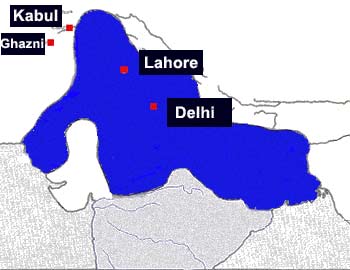
Extent of empire of Iltutmish
Initially, Iltutmish acknowledged Yalduz's suzerainty by accepting the symbolic presents. In 1215-1216, Yalduz, who had been defeated and expelled from Ghazni by the forces of the Shah of Khwarezm, moved towards Punjab and laid claim to the throne of Delhi as the heir to Muhammad of Ghor. Iltutmish refused, stating

"The dominion of the world is enjoyed by the one who possesses the greatest strength. The principle of hereditary succession is not extinct but long ago destiny abolished this custom."

Iltutmish defeated Yalduz at Tarain. Yalduz was imprisoned in Badaun and was later executed.

In 1217, Iltutmish moved towards Qubacha at the head of a large army. Qubacha attempted to retreat from Lahore towards Multan but was defeated at Mansura. Iltutmish refrained from attacking Sindh due to the presence of Mongols on his north-west frontier. Iltutmish was preoccupied with the Mongol threat and did not threaten Qubacha until 1227.

Mongol threat:

In 1221, the Mongols, under Chenghiz Khan appeared for the first time on the banks of the Indus. They had overrun the countries of Central and Western Asia with lightning rapidity. The Mongols captured Khiva and forced its ruler, Jalal-ud-din Mangabarni to flee to the Punjab. He sought asylum in the dominions of Iltutmish. The Sultan of Delhi refused to comply with the request. Mangabarni entered into an alliance with the Khokhars, and after defeating Qabacha, plundered Sindh and northern Gujarat and went away to Persia. The Mongols also retired. India was thus saved from a terrible calamity, but the menace of the Mongol raids disturbed the Sultans of Delhi in subsequent times.

Consolidation of power:

With the death of Genghis Khan in 1227, Iltutmish attacked Qubacha. Multan and Uch were captured. Qubacha was surrounded on all sides in the fort of Bhakkar, on the banks of Indus. He drowned while attempting to escape. Sindh and Multan were incorporated into the Delhi Sultanate and placed under separate governors.

Southern Bihar was captured by Iltutmish in 1225-26. Lakhnauti was captured in 1226. Revolts continued until the Khalji Maliks of Bengal were reduced to complete submission in the winter of 1231.

Due to his problems first with Turkish nobles and then with the Mongols, Iltutmish had ignored the Rajputs, who had regained territory lost earlier to the Turks, for the first fifteen years of his reign. Starting in 1226, however, Iltutmish began a series of campaigns against the Rajputs. Ranthambore was taken in 1226, Mandsaur in 1227. Bayana, Ajmer and Sambhar were also captured. Nagaur was captured in 1230 and Gwalior in 1231.

Innovation:

Coins -

Coins of Iltutmish
Iltutmish introduced the silver tanka and the copper jital - the two basic coins of the Sultanate period, with a standard weight of 175 grains. 

Iqta System -

The Iqta system was a practice of tax farming that was introduced by Iltutmish in the Delhi Sultanat. It was basically grant of revenue from a territory in lieu of salary. This grant was not hereditary and was subject to passing from officer to officer. The Iqta system linked the farthest of the Sultanate to the central Government.

He also organized a group of 40 loyal nobles - Turkan-i-Chahalgani or Corps of Forty.

Organization of Army -

Iltutmish organized the army of the Sultanate and made it "kings’ army" which was centrally recruited and centrally paid.

Architecture -

He built the Hauz-i-Shamsi reservoir in Mehrauli in 1230, which also has Jahaz Mahal standing on its edge, used by later Mughal Emperors. He built Gandhak-ki-Baoli, a stepwell for Sufi saint, Qutbuddin Bakhtiar Kaki, who moved to Delhi during his reign. In 1231, he built Sultan Ghari, he built the mausoleum of his eldest son, Prince Nasir-ud-din Mahmud, which was the first Islamic Mausoleum in Delhi. He also completed the construction of Qutb Minar.

Death and succession:

In 1236 Iltumish died, and buried with the Qutb complex in Mehrauli.

Iltutmish's eldest son, Nasir-ud-din Mahmud, had died in 1229 while governing Bengal as his father's deputy. The surviving sons of the Sultan were incapable of the task of administration. In 1236 Iltutmish, on his death-bed, nominated his daughter Raziya as his heiress. But the nobles of the court were too proud to bow their heads before a woman, and disregarding the deceased Sultan's wishes, raised to the throne his eldest surviving son, Rukn-ud-din Firuz.

The death of Iltutmish was followed by years of political instability at Delhi. During this period, four descendants of Iltutmish were put on the throne and murdered. Order was re-established only after Balban became the Naib or Deputy Sultan and later on Sultan in 1265.

Estimate of Altamash as a ruler:

Iltutmish re-established the territorial integrity of the Delhi Sultanate created by Aibak and which was in danger of being split up. He defeated efforts of ambitious rivals like Yalduz and Qubacha to divide the sultanate. In the process, he displayed a great deal of tact, patience and far-sightedness. Thus, he bided his name till he was in a position to take decisive action. This was displayed in his dealings with Qubacha as well as Jalaluddin Mangabarni. Early in his reign he realized that his policy must be one of steady consolidation rather than rapid expansion. He proceeded against the Khalji Mailks of Lakhnauti only when he had consolidated his position in the north-west.

It was under him that the Delhi Sultanat can be called a truly independent state, not tied up to a foreign sovereign living at Ghazni or Ghur. His legal status as an independent sovereign was re-affirmed in the eyes of the Muslims when in 1229 an envoy of the Caliph of Baghdad reached Delhi with a formal letter of investiture for him. Although, it was a mere formality and recognition of an accomplished fact, he made the visit a grand occasion.

Tomb of Iltutmish
He can be credited with making Delhi, the political, administrative and cultural centre of Turkish rule in India. His steady presence at Delhi was a major factor in this as also the fact that Delhi became refuge nobles, bureaucrats, scholars, poets and religious divines from Central Asia to escape the Mongol depredations. He beautified Delhi by setting up new buildings. The most notable example of this was the tower or minar, later called the Qutb Minar, commenced by Qutbuddin which he completed. Soon a magnificent city arose in the environs. The Hauz Shamsi, south of Qutb Minar and the madrasah around it, was built by him. He was not only a patron of men of learbing and poets; he also accorded great honour to sufi saints of his time, such as Qutbuddin Bakhtiyar Kaki.

By his military prowess, pleasing manners and liberality, he earned deep respect and attachment of the people of Delhi to his family, in consequence of which the right of his children to succeed him was accepted. Thus, he set up the first hereditary sovereignty at Delhi. However, his children were not successful because he had not been able to create a well-knit and compact state. The state was still a loose structure in which the inner jealousness and rivalries of the Turkish nobles and slave officers could be kept under control only by a strong ruler.

References :

Medieval History by Satish Chandra